The Surface Beneath the Strike
In every old blacksmith’s forge, there is a surface that does not move. It may be a bench, a block, a stone, or a heavy piece of iron set low enough for force and high enough for control. It does not look like the most dramatic tool in the room. It does not shine like a blade. It does not swing like a hammer. It does not burn like the fire. But without it, the work cannot hold its shape.
The blacksmith knows this. Heat matters. Strength matters. Timing matters. But when the metal is pulled from the fire and brought under the hammer, the strike needs a place to land. The steel has to meet something steady. If the surface gives way, shifts, tilts, or shakes, the blow loses its aim. The force is still there, but it spreads. The effort is still real, but the result is poor.
Most people speak about growth as if it happens only inside the will. They tell a man to try harder, wake earlier, push longer, focus better, eat cleaner, and stop making excuses. There is truth in that. No man can outsource his choices. But that way of speaking leaves out a fact so basic that we often miss it: effort needs a place to land.
A man’s environment is not the background of his growth. It is the surface that receives his effort. If that surface is unstable, cluttered, loud, or built for distraction, his discipline will keep leaking into daily fights that never should have been needed. The issue is not only weak will. The issue is will placed on a weak Anvil.
The Modern Man Lives on Unstable Ground
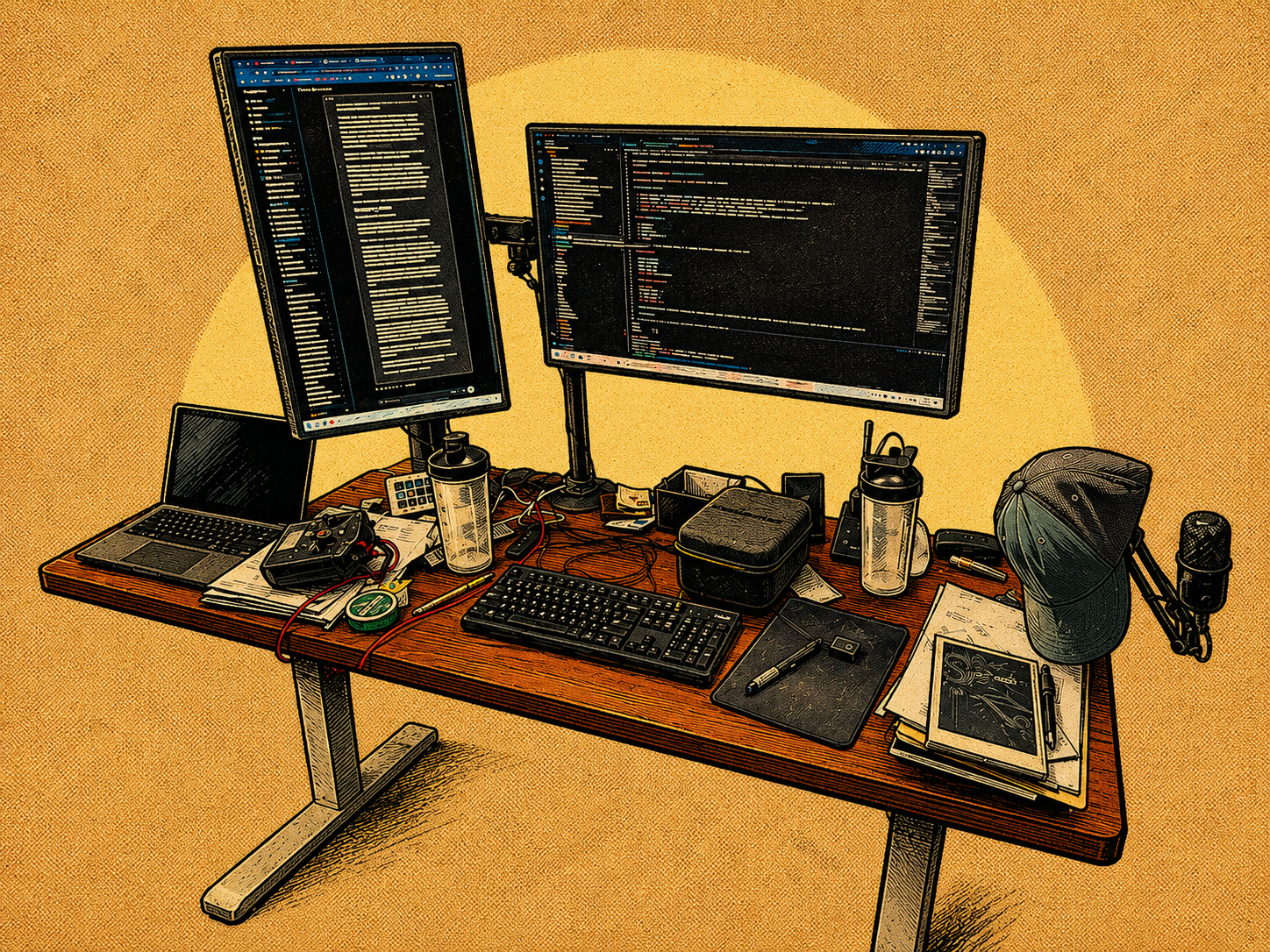
A man may say he wants to focus, but his desk tells a different story. The bills are stacked beside the laptop. The old cup is still there. The tools are half sorted. The phone sits face up, ready to flash. A dozen tabs are open. The chair is poor. The room is loud. Before he has done one hour of clean work, he has already spent energy fighting the place where the work is supposed to happen.
He may say he wants to eat better, but his kitchen has been arranged by impulse. The quick food is easy. The better food is hidden, unwashed, or not there at all. At night, when his energy is lower and his guard is weaker, the room gives him the same offer it gave him yesterday. He does not only fight hunger. He fights layout, habit, smell, ease, and memory.
He may say he wants to sleep, but his bedroom is a second living room, a theater, an office, and a phone dock. The bed is not treated as a place for rest. It is treated as a place for scrolling, watching, worrying, and drifting. Then he wonders why his mind does not shut down when he tells it to.
These are not small details. They are daily instructions.
A space teaches. It tells the body what happens here. It tells the mind what comes next. A clean work surface says begin. A clear kitchen says choose well. A dark quiet room says rest. A charged phone beside the bed says reach. A gaming console in the bedroom says stay up. A feed full of anger says stay tense. A fridge full of junk says give in.
Over time, the environment stops feeling like a set of choices and starts feeling like normal life. That is how men get trapped. Not always by one large failure, but by hundreds of small cues that push the same old direction.
When the Wrong Thing Is Easier
The strongest force in a common day is often ease.
Not belief. Not courage. Not desire. Ease.
The right action may matter more, but the easier action often arrives first. The phone is easier than the book. The snack is easier than the meal. The couch is easier than the walk. The open app is easier than the blank page. The old room is easier than the new rule.
This does not mean a man is helpless. It means he must stop lying about the field he is standing in.
If every good action requires a debate, and every bad action sits within arm’s reach, the day will become a long chain of small losses. The man will still talk about goals. He may still believe in them. But belief does not clear the desk. Belief does not silence the phone. Belief does not remove the bottle, the junk food, the late night screen, or the noise that keeps breaking his focus.
The environment decides which action has the shorter path.
That is why a serious man does not only ask, “What do I want?” He asks, “What have I made easy?”
If focus matters, then focus needs a place. If health matters, then health needs a setup. If sleep matters, then sleep needs protection. If training matters, then the gear must be ready. If family matters, then the room must stop being ruled by glowing screens and half attention.
A strike does not become useful because the smith wishes it so. It becomes useful when force meets a surface strong enough to return that force back into shape. The environment must do the same. It must return your effort back into your life, not swallow it into clutter and noise.
The Digital Room in Your Pocket
The modern environment is not only physical. You now have a room in your pocket. It has doors, voices, arguments, temptations, memories, images, and traps. It can be opened in bed, at work, in the car, at dinner, in the bathroom, and in the quiet space where thought used to form.
The phone is not just a device. It is a portable environment. It has its own weather.
When its alerts are always on, it trains reaction. When the home screen is full of low value apps, it trains drift. When the feeds are built on outrage, lust, envy, and noise, they train a man to live outside himself. He starts the day looking at other people’s demands, bodies, opinions, wins, fights, and fears. Then he wonders why his own life feels distant.
This is not a call to hate technology. A tool is not the enemy. A bad setup is the enemy. A hammer can build or break. A phone can serve or rule. The digital room must be arranged like any other room.
The useful tools should be easy to reach. The waste should be harder to reach. The noise should be silenced. The feeds should be cleaned. The apps that keep stealing hours should be removed, hidden, blocked, or made costly to open. The phone should have a job. If it does not have a job, it will give the man one: react.
A man who wants a clean mind cannot keep living inside a dirty digital room.
Why Willpower Gets Too Much Credit
Some will argue that a man should not need a perfect room to do hard things. He should be able to focus in noise. He should be able to refuse junk food. He should be able to ignore the phone. He should be able to push through clutter, stress, and temptation. He should build willpower, not depend on clean conditions.
There is truth here. Life will not always be arranged for him. He must be able to act under pressure. He must be able to stay steady when the room is not. He must not become so fragile that one distraction ruins him.
But this view is incomplete. Training under pressure is not the same as living under needless friction. A soldier trains with weight, but he does not fill his boots with gravel before every march. A craftsman learns to work through hard problems, but he does not leave his tools scattered across the floor to prove his resolve. A smith respects fire, but he does not let trash pile up near the forge and call the danger discipline.
There is a difference between hardship that builds you and disorder that drains you.
Willpower is real, but it is not meant to carry the full weight of a poorly arranged life. When men praise willpower too much, they often excuse lazy design. They turn avoidable friction into a badge of toughness. Then they burn energy on battles that could have been prevented with one clear rule, one removed app, one clean surface, one better shelf, one quiet hour, one phone left outside the bedroom.
The point is not to make life soft. The point is to make effort count.
Hard work should be spent on the mission, not wasted on fighting the mess that surrounds it.
The Audit as an Act of Ownership
You’ve been told discipline should be enough. You’ve been told a strong man should be able to focus anywhere, eat right around junk, sleep well beside a glowing phone, work clearly at a cluttered desk, and keep his mind sharp while his screen keeps feeding him noise.
That sounds tough. Most of the time, it is just careless.
An audit is not a mood. It is not a wish. It is not the vague feeling that your life should be cleaner, quieter, or more under control. An audit is an inspection. It asks you to walk through your spaces and tell the truth about what they are training you to do.
You need to inspect your home. You need to inspect your workspace. You need to inspect your digital life. Not with shame. Not with excuses. With force and clarity.
Each area must answer one question: does this support the man you are becoming, or does it keep feeding the man you are trying to leave behind?
The audit begins with friction.
Friction is anything that makes the right action harder or the wrong action easier. The phone beside your bed. The snacks in your cabinet. The television in your bedroom. The messy desk. The loud notifications. The dirty kitchen. The tools that never have a place. The app that turns five minutes into forty. The chair that makes work painful. The feed that leaves your mind bitter. The room that keeps saying, “Not now.”
You need to name your top three to five points of friction.
They must be concrete.
Do not write, “I get distracted.” That is too vague. Write, “I check my phone every time work gets hard.”
Do not write, “My house is messy.” Write, “My kitchen counter is so cluttered that cooking feels harder than ordering food.”
Do not write, “I sleep badly.” Write, “I charge my phone by the bed and scroll for an hour after lights out.”
Once you name the friction, you can see the opposite state.
A desk with only the tools needed for the day. A kitchen where good food is visible and ready. A bedroom where the phone does not sleep beside you. A home screen built around tools, not traps. A chair and lamp that make focused work less costly. A quiet corner for reading, prayer, planning, or training. A wall with written goals where your eyes land each morning.
This is not decoration. This is design.
The last step matters most: make one key change.
Not a fantasy plan. Not a weekend of rage cleaning that collapses by Tuesday. One change that alters daily behavior. Remove one obstacle or add one support.
Throw out the junk. Move the charger. Delete the app. Clear the desk. Put the shoes by the door. Turn off the alerts. Set the lamp. Move the television. Build the shelf. Put the written goal in sight.
Then watch the result.
Did work start faster? Did sleep come easier? Did the phone lose some power? Did the better meal become more likely? Did the room stop arguing with the goal?
The answer will teach you more than theory.
The Man Becomes What His Space Repeats
You’ve been told your beliefs shape your life. That is true, but it is not the whole truth.
You are not only shaped by what you believe. You are shaped by what you repeat. And what you repeat is shaped, in part, by what your environment makes obvious, easy, hidden, costly, or normal.
This is why the Anvil matters.
The Anvil does not replace the hammer. Your environment does not replace discipline. But the Anvil gives discipline a surface that can hold the strike. It makes effort cleaner. It gives force a better chance to become shape.
A cluttered, loud, tempting, careless environment does not prove you are strong. It proves you have accepted drag as normal.
If you keep fighting the same avoidable battles, you may call it grit. But much of it is waste. You are spending strength on resistance instead of formation.
A better environment will not make you great by itself.
No cleared desk writes the report. No clean kitchen lifts the fork. No silent phone builds the business. No neat room becomes character on its own.
But each one lowers the cost of the next right action. Each one removes a small excuse. Each one gives you a stable place to strike.
That is the larger point.
Growth is not just a private feeling. It is built into rooms, tools, screens, schedules, kitchens, beds, and paths. The world around you is either arranged by your lower impulses or by your chosen identity. There is no neutral ground.
The audit is not about having a perfect space. It is about taking command of the surface beneath your effort.
Ignore that surface and you will keep wondering why your strikes do not hold shape. Restore it and you will still have to work, but your work will finally land.
So inspect the Anvil.
Clear what weakens the strike. Place what supports the work. Make the right action easier to begin and the wrong action harder to repeat.
Your space is already voting on who you become.
Take back the vote.