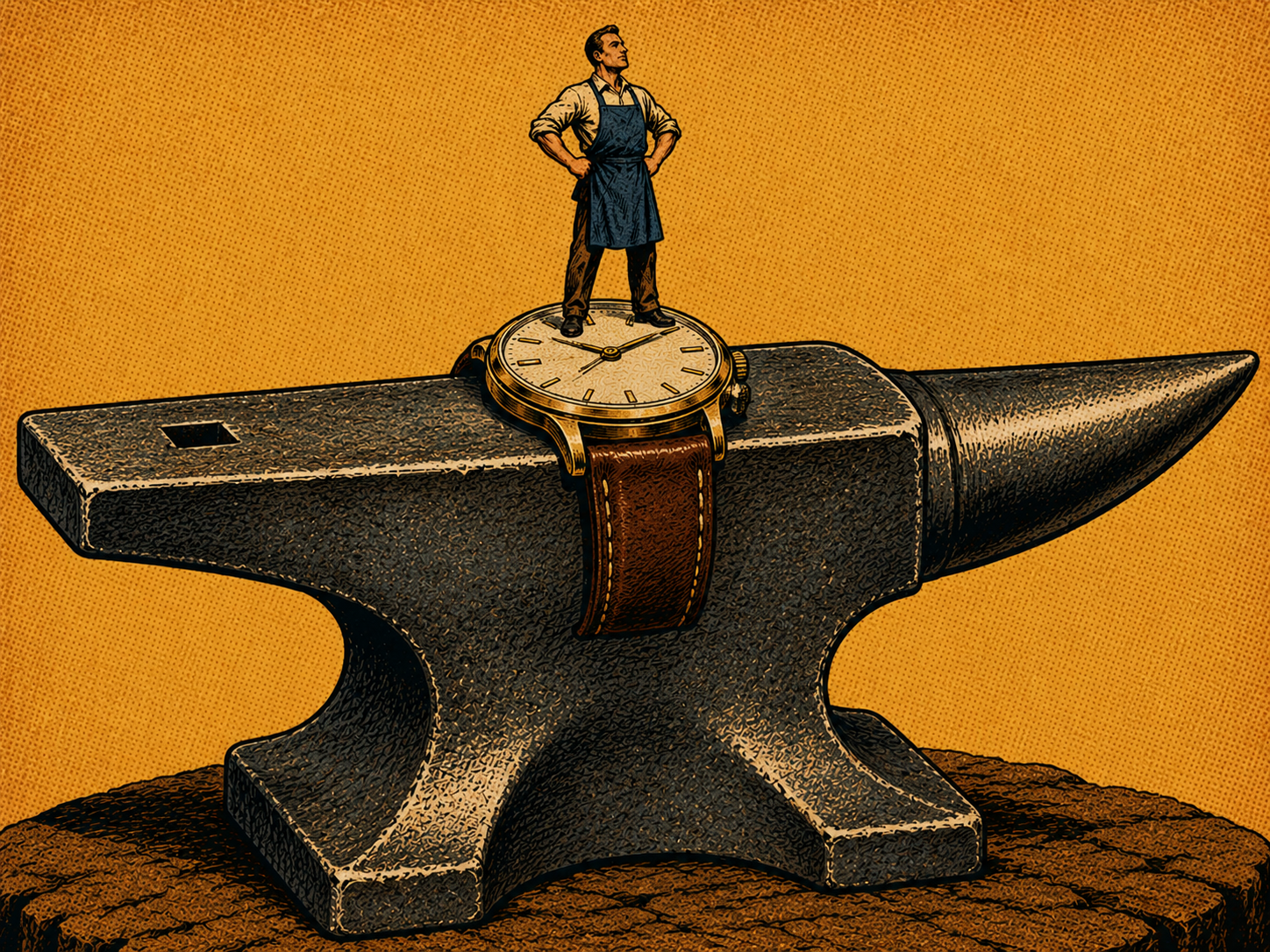
The Workshop at the End of the Day
It is a little after nine at night, and the room has gone quiet in the way rooms do when a day has ended but has not been closed. There is a plate in the sink. A pair of shoes sits near the door. A phone glows in one hand. The television is on, though no one is really watching it. The body is tired, but not in the clean way that follows honest work. It is the dull tiredness of being pulled in too many directions without being fully present in any of them.
A man may tell himself this is rest. Maybe it is, for a few minutes. But then the few minutes become an hour. The hour becomes the new bedtime. The new bedtime becomes the weak morning. The weak morning becomes the rushed breakfast, the missed workout, the short temper, the scattered workday. By Thursday, he is not dealing with one bad night. He is living inside the shape of a routine he has not inspected.
I think most people understand this in a vague way. We know our days matter. We know sleep matters. We know the phone is not innocent. We know a morning can be lost before it begins. But there is a gap between knowing these things and seeing the hidden law beneath them: a life is not shaped mainly by the goals a person announces. It is shaped by the ordinary workshop where his hours are spent.
That workshop is the daily routine.
The Quiet Problem Beneath the Habit
It is tempting to talk about habits one at a time. Wake up earlier. Eat better. Train more. Scroll less. Read before bed. These are useful actions, but they can also become a scattered pile of tools on the floor. A man may have a hammer, a file, a broom, and a measuring tape, but if the workshop itself is in disorder, each tool becomes harder to use.
This is the difference between a habit and a routine. A habit is a repeated action. A routine is the whole room that action lives inside. The morning does not only contain a workout. It contains the alarm, the phone, the light in the room, the clothes laid out or not laid out, the sleep from the night before, the first thought that gets attention, the first decision that creates momentum or drag. The evening does not only contain rest. It contains dinner, cleanup, the work boundary, the screen, the unfinished conversation, the open loop from tomorrow, and the quiet permission to drift.
Here is the interesting part: many men stgruggle because their habits are trapped in a bad routine. They have one or two good tools, but the workshop keeps putting them out of reach.
A man says he wants to train, but the gym block sits after a long commute, a heavy dinner, and thirty minutes on the couch. He says he wants to be more present at home, but work email follows him to the table. He says he wants better sleep, but the phone sleeps beside him like a loaded tool. He says he wants to build a skill, but the only open time is the hour when his mind is already dull. This shows that the workshop has not been arranged for the work he claims to value.
That may sound like a smaller problem than identity, purpose, or discipline. I think it may be the more useful one.
When Motivation Has Nowhere to Live
There is a common criticism that shows for many men: I need to stop bneing lazy. Sometimes that is true in the simple sense that people choose comfort when they should choose effort. But a lot of drift happens because the day has no strong shape. Motivation rises for a moment, then has nowhere to land.
Psychologists sometimes talk about cognitive load. In plain words, this means the mind has a limited amount of space to hold decisions, worries, tasks, and temptations at once. When too many things are open, the brain looks for the easiest exit. The phone becomes easy. The couch becomes easy. Fast food becomes easy. Not because the man values them most, but because they ask the least from a mind that is already carrying too much.
This is why a routine matters. A good routine lowers the number of times a man has to negotiate with himself. It does not make him a machine. It makes him less dependent on mood. The workout already has a place. The phone already has a limit. The meal is already planned. The workday already has an ending. The evening has a closing ritual. The workshop has a place for each tool, so the work can begin without a search party.
The fire inside a man, his direction, does not usually die in one dramatic moment. It gets scattered by a hundred small openings. The morning scroll. The late start. The skipped meal. The open browser tab. The lazy transition after work. The unfinished task dragged into family time. The night that never quite shuts down. These are not just time issues. They are direction issues. They slowly teach a man that his stated life and his lived life are two different things.
A man can survive that split for a while. Many do. But over time, the split becomes heavy. He begins to distrust himself. Not because he is dishonest in some grand moral sense, but because his repeated hours keep voting against his stated aims.
This is where the furnace matters. Not as a symbol of harsh discipline, but as a structure that protects the fire from weather. A man rarely needs more speeches about wanting a better life. He needs a day that makes the better action easier to reach.
The First Hour and the Last Hour
If a man wants to inspect his routine, he should start where the day is most fragile: the first hour and the last hour.
The first hour often tells the body what kind of day it has entered. If the first act is scrolling, the mind begins in reaction. Other people’s lives, needs, noise, anger, jokes, headlines, and updates get first access. The man has not yet chosen his own direction, but the world has already chosen one for him. By the time he stands up, he may already feel behind, irritated, or numb. Nothing dramatic happened. The workshop door opened, and the wrong tools were already in his hands.
The last hour may be even more important. It is easy to treat it as leftover space, the part of the day that belongs to whatever is easiest. But the last hour builds the next morning. A late screen does not stay in the night. It enters the alarm. A messy kitchen does not stay in the evening. It greets the next day. Avoided planning does not disappear. It becomes morning fog. The workshop is not cleaned, so the next shift begins in yesterday’s ash.
This does not mean every night must become a ritual of grim discipline. A man is not improved by turning his life into a punishment. But a life without closure stays open in the mind. It keeps asking to be handled. The body lies down, but the workshop remains lit, cluttered, and humming.
What I’ve started noticing is that many routines break less from major failure than from bad transitions. Waking to working. Working to home. Dinner to evening. Evening to sleep. These hinges carry the day. If they are loose, the whole structure shakes.
The after-work collapse is one of the clearest examples. A man comes home tired. He sits down for a minute. The minute is fair. The problem is that the minute has no boundary. It turns into a fog. Training gets skipped. Dinner gets delayed. The children get the dull version of him. The night gets pushed back. He tells himself he needed rest, but the rest did not restore him. It only absorbed him.
A better routine would not demand heroics at that moment. It would make the next right action obvious. Change clothes before sitting down. Walk for ten minutes before entering the house if the workday needs to be shaken off. Put the phone in another room during dinner. Set a hard end to work. Keep the workout bag visible. These are not life hacks. They are the layout of the workshop.
Why Willpower Is a Poor Architect
I want to be careful here. A routine audit can become another way for a man to hate his limits. That is not the point. The point is not to account for every minute like a prison guard. It is to learn which parts of the day are carrying weight and which parts are leaking it.
Willpower is useful, but it is a poor architect. It can force an action once. It can push through a hard morning. It can help a man say no when temptation is close. But if the workshop stays disordered, willpower has to keep doing work that design should have handled.
A man who keeps junk food in the house and then praises himself for resisting it every night is wasting strength. A man who keeps his phone beside the bed and then fights it every morning is wasting strength. A man who schedules deep work during his lowest energy and shallow work during his clearest hours is wasting strength. The point of structure is not to prove virtue. It is to stop spending force in foolish places.
The habit and routine audit begins with a plain record. Write down one full day, hour by hour. Not the ideal day. Not the day that makes you look disciplined. The actual day. Wake time. Phone time. Work time. Food. Commute. Chores. Training. Family. Rest. Drift. Sleep.
This is not glamorous work. It is inspection. A craftsman does not improve the workshop by standing in the doorway and feeling vaguely dissatisfied. He walks the room. He checks the bench. He looks at the floor. He sees where the tool went missing. He sees where the ash built up. He sees where the light is poor. He sees where the work keeps getting interrupted.
Once the day is mapped, two questions matter.
Where is the weak link?
Where is the strong platform?
The weak link is the place where time loses its shape. It may be the first thirty minutes in the morning. It may be lunch. It may be the hour after work. It may be late night. It may be the space between putting kids to bed and going to sleep. The weak link is not always the largest block. It is the block that poisons the next one.
The strong block is the part of the day where the man is already more alive, more useful, or more aligned. Maybe early morning focus is strong. Maybe the workout is working. Maybe dinner is a steady place in the family. Maybe the first two hours at work are sharp. A wise man does not only attack weakness. He protects strength.
The audit asks for one cut and one reinforcement. Cut or improve one low-value block. Amplify or protect one high-value block. That is enough for the week. More than that often becomes theater.
The Life That Becomes Useful
It may seem strange to connect a daily routine to contribution, but the connection is direct. A disordered routine rarely stays private. It spills.
A tired man brings less patience home. A scattered man brings less focus to work. A man who never protects his body becomes less available to the people who depend on him. A man who gives his best attention to a screen has less attention left for his children, his spouse, his craft, his community, or his calling. The workshop may be private, but the work that comes out of it is not.
This is where the forge appears. The inner life must become useful outside itself. Better routines are not only about getting more done. They are about becoming more reliable in the places where reliability matters. The man who sleeps better may listen better. The man who plans his day may lead with less panic. The man who protects his training may carry himself with more steadiness. The man who stops letting work invade dinner may teach his home that presence is not what remains after ambition is finished.
This does not explain everything. Some men are carrying real burdens: night shifts, young children, financial pressure, illness, grief, unstable work, aging parents. A routine audit should not pretend that every life has the same amount of control. But almost every life has some repeatable space. Some hinge. Some leak. Some tool that can be moved closer. Some ash that can be cleared.
The question is not, “Can I design the perfect day?”
The better question is, “What is one part of my day I can stop surrendering?”
That question is small enough to answer and large enough to matter.
Returning to the Workshop
At nine at night, the same room is still there. The plate may still be in the sink. The shoes may still be near the door. The phone may still glow in the hand. But after the audit, the scene means something different.
It is no longer just a man relaxing. It may be a man standing in the workshop at the exact point where tomorrow is being made. That hour is not empty. It is forming something. It is either cleaning the bench or adding to the clutter. It is either closing the day or leaving it open. It is either protecting the morning or stealing from it early.
The day does not ask what kind of man you want to be. It trains the man you repeatedly practice being.
A routine audit is not a call to become severe. It is a call to become honest. Look at the workshop. Find the leak. Protect the strong block. Move one tool. Clear one surface. Close one hour better than before. Then see what changes when the day stops fighting the life you claim to want.
The man on the couch does not need to hate himself for being tired. But he does need to tell the truth about what that hour is doing. If it restores him, let it restore him. If it steals from him, let him name it.
The workshop will keep making someone.
The only question is whether he will inspect it before it makes the same man again.