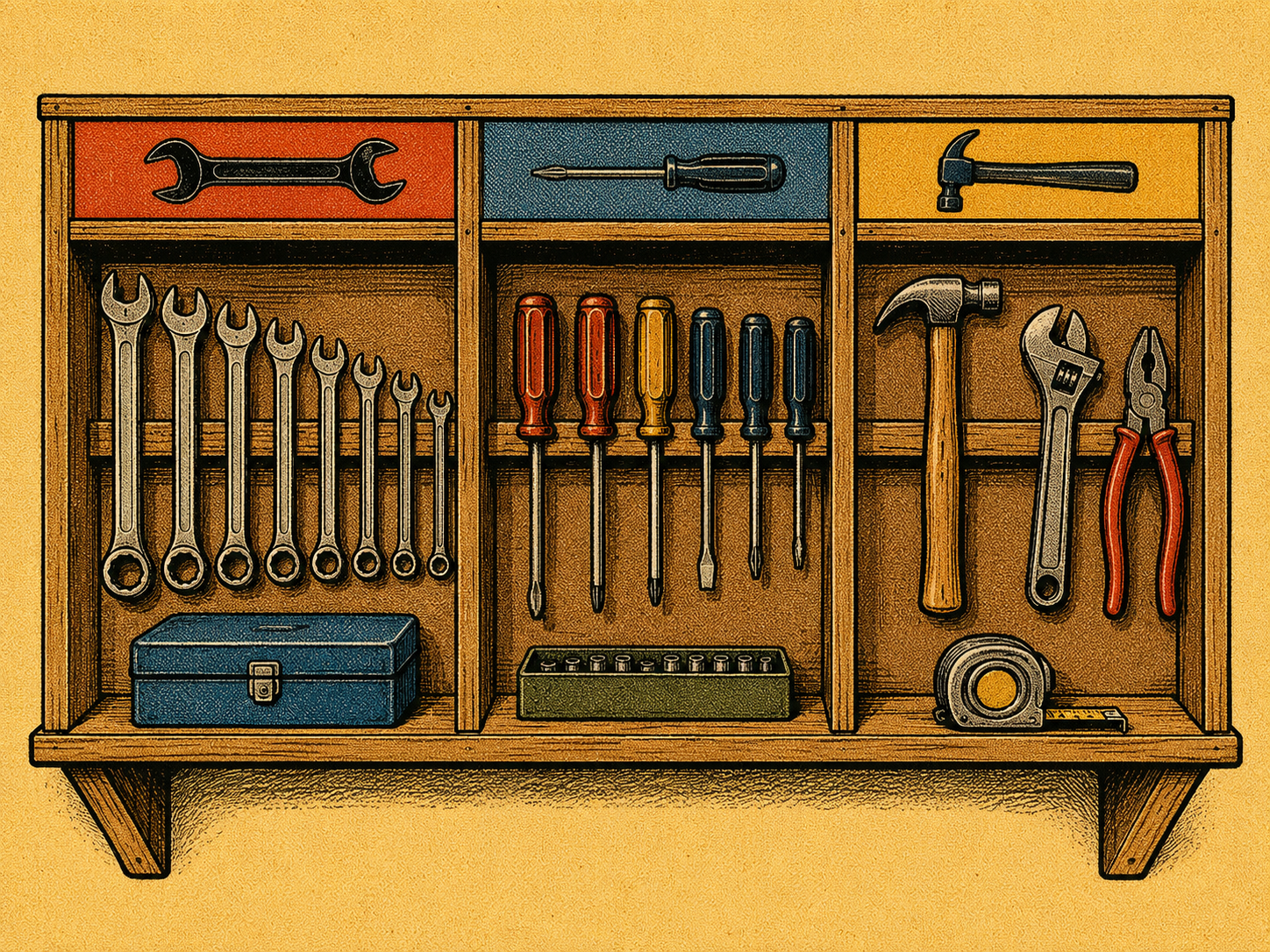
The Shelf in the Garage
There is a shelf in my garage that has been bothering me for months.
It is not broken. It does not lean. Nothing is falling from it. From a distance, it looks useful.
Up close, it tells a different story.
There are old paint cans on the top shelf. A box of wires sits under a bag of grass seed. Two drill bits are loose beside a tape measure. A small plastic bin is marked “TOOLS,” but it holds batteries, receipts, and one glove.
Every few weeks, I stand in front of that shelf and decide I should fix it.
I notice what is wrong. I can name the problem. I know what should move. Then I close the garage door and walk back inside.
The shelf stays the same.
I think many parts of life work this way.
We notice the bad habit. We see the weak routine. We know which person keeps pulling us into the same argument. We understand that our sleep is poor, our phone use is too high, or our time is being spent on work that does not matter.
We are not blind.
The problem is not always a lack of insight.
The problem is that insight often stops before it becomes structure.
Seeing Is Not Changing
There is value in honest review.
You cannot repair what you refuse to inspect. A man who never looks at his spending will keep wondering where his money went. A man who never reviews his week will keep calling the same failures bad luck. A man who never studies his habits will keep blaming his mood.
But review has a limit.
Once the pattern is clear, more review can become a way to delay action.
This is where things become strange. A man can become very skilled at explaining why his life is not working. He can name every cause. He can describe every mistake. He can trace the problem back for years.
Yet the next morning still looks the same.
He wakes late. He checks his phone. He skips breakfast. He starts work without a plan. He promises to do better tomorrow.
His understanding has grown, but his behavior has not.
I want to be careful here. Reflection is not useless. The smaller claim is actually more interesting.
Reflection becomes useful only when it changes what happens next.
A clear thought must become a clear rule.
A lesson must enter the calendar.
A value must change a choice.
A problem must lose access to the conditions that keep feeding it.
Until that happens, insight is only stored heat.
It may feel powerful, but it is not yet doing work.
Heat Needs a Place to Go
A furnace does not become useful because it contains heat.
It becomes useful because the heat is held, directed, and released with purpose.
Without structure, heat escapes. It spreads into the room. It burns fuel without shaping anything.
Human effort works the same way.
You can care deeply about your family and still answer work messages during dinner. You can want better health and still leave every workout to chance. You can value order and still begin each morning in a room filled with yesterday’s mess.
The fire may be real.
The direction may be honest.
But the furnace is weak.
The structure around your effort does not protect what you say matters.
This is why people often think they need more motivation. They assume the problem is low desire. They wait for stronger emotion, a better mood, or a fresh start.
But people rarely need more heat.
They need fewer leaks.
A phone beside the bed is a leak.
A calendar with no protected time is a leak.
A friendship built around complaint is a leak.
A rule that changes every day is a leak.
A goal with no measure is a leak.
Each one allows energy to escape before it can become useful action.
The obvious question becomes: what should change first?
The Cost of Trying to Fix Everything
When a man sees many weak points at once, he often makes one of two mistakes.
He does nothing because the list feels too large.
Or he tries to change everything at the same time.
The second mistake looks more serious. It feels like commitment. New routines are written. Apps are removed. Food is thrown away. Alarms are set. Books are ordered. A full new life is planned before bed.
By the end of the week, most of it is gone.
This is not because the man is weak.
It is because the plan asks too much structure to appear at once.
Attention has limits.
Time has limits.
Energy has limits.
A furnace can only hold and direct so much heat before the walls begin to fail.
This matters because progress depends on concentration.
A small number of changes, repeated long enough, can begin to support one another.
Better sleep may improve training.
Better training may improve patience.
More patience may improve family life.
A cleaner work area may reduce delay.
Less delay may improve output.
Better output may reduce late-night work.
One change can strengthen several parts of life.
But this only happens when the change is chosen with care.
Not every problem deserves equal attention.
Some issues are loud but small. Others are quiet and costly.
A messy drawer may bother you. Poor sleep may shape your whole day.
A missed email may create tension. Constant phone checking may destroy hours each week.
A single hard talk may feel uncomfortable. Avoiding it for six months may weaken trust every day.
The task is not to choose the easiest fix.
The task is to find the changes with the widest reach.
The Three That Matter
What I have started noticing is that most people already know several things they could improve.
The harder work is deciding which three deserve action now.
That decision requires honesty.
You must look at frequency.
How often does the problem happen?
You must look at cost.
What does it take from you?
You must look at reach.
How many parts of life does it affect?
A weak routine that happens every morning has more weight than a problem that appears twice a year.
A habit that damages sleep, focus, work, and family has more reach than one that causes mild annoyance.
A relationship that keeps pulling you back into old behavior may need more attention than a task you simply dislike.
This kind of choice can feel narrow.
It is supposed to.
A priority is only real when something else is placed below it.
You are not saying the other problems do not matter.
You are deciding that three of them will no longer be allowed to remain vague.
That is a different kind of commitment.
You are not trying to become a new man by Monday.
You are choosing three places where the old pattern will stop receiving easy access.
Rules Carry What Intentions Drop
Habits remember what intentions forget.
That is why a good plan must become a rule.
“Use my phone less” is not a rule.
“Leave my phone in the kitchen at 10:00 each night” is a rule.
“Spend more time with my family” is not a rule.
“Eat dinner without a phone five nights this week” is a rule.
“Get in shape” is not a rule.
“Train Monday, Wednesday, and Saturday at 6:30” is a rule.
The difference is simple.
A wish describes what you hope will happen.
A rule tells you what to do when the moment arrives.
Rules protect action from daily debate.
Without them, the ego bargains.
It says tonight is different.
It says work was hard.
It says one missed day will not matter.
It says you can begin next week.
A clear rule ends the argument early.
It removes the need to decide again.
This is not harsh. It is useful.
Structure preserves energy because it reduces the number of choices you must make under pressure.
The furnace holds because the walls are already in place.
Support Is Not Weakness
Even a clear rule can fail when the setting around it stays the same.
A man may decide to stop checking his phone in bed, but the charger remains on the nightstand.
He may plan to train before work, but his clothes are still in the laundry basket.
He may want quiet time with his family, but no one knows that dinner is meant to be protected.
He may set a boundary, then answer every message the moment it arrives.
The rule is clear.
The environment still works against it.
This is where support matters.
Support may be a reminder.
It may be a prepared room.
It may be a person who expects an honest report.
It may be a blocked hour.
It may be removing the easy path to the old habit.
People often call this a lack of discipline. Sometimes that is true.
But failure is usually more traceable than that.
If you forget, build a reminder.
If you avoid, add a witness.
If the action is too large, reduce the first step.
If another person keeps crossing the line, state the boundary before the next test.
If one missed day becomes a lost week, create a rule for restarting.
The goal is not to build a life where discipline is never needed.
The goal is to stop wasting discipline on problems that can be solved through structure.
Proof Before Belief
Identity quietly keeps score.
You may tell yourself that you are disciplined, but your habits keep their own record.
You may say family comes first, but your phone knows how often dinner is interrupted.
You may say health matters, but your calendar knows whether training has a place.
You may say the work is important, but your week knows how often you begin.
This does not mean identity is false.
It means identity becomes believable through proof.
One completed action is small.
Seven days of completed action is still small.
But repeated action begins to build a record.
The record matters because the mind quietly assumes that the past will continue.
When you break the pattern, even in a small way, you create new evidence.
Five nights with the phone outside the bedroom.
Three completed workouts.
Four dinners without a screen.
One hard conversation finished.
One week of spending reviewed.
These are not final victories.
They are proof that the structure is beginning to hold.
Progress compounds because each kept rule makes the next kept rule more believable.
The furnace becomes stronger as it proves it can contain the heat.
Back to the Shelf
The garage shelf will not change because I understand it.
It will not improve because I have stared at it long enough.
It will change when I choose what belongs there, remove what does not, and give each useful thing a place.
The shelf is not asking for a better opinion.
It is asking for a decision.
Life often asks the same.
You may already know what is draining your time.
You may already know which habit keeps weakening your mornings.
You may already know which value is missing from your calendar.
More thought may not be the answer.
The next step may be smaller and harder.
Choose what matters.
Give it a rule.
Build the support.
Then let the week show whether the structure can hold.
What You Do Next
Choose three. Write down the three repeated problems with the greatest cost and widest reach.
Write one rule for each. Give every change a clear action, time, frequency, and visible mark of completion.
Track seven days. Record what you did, review the result, and adjust the structure without dropping the goal.
You can keep standing in front of the same shelf, naming the same disorder.
Or you can decide where things belong and begin putting them there.