The Stories We Inherit
A man in his forties sits across from a friend and tells a familiar story.
He explains why he never asks for help. Why he keeps people at a distance. Why every success feels temporary and every failure feels permanent. He describes these things as personality traits, facts about who he is, features of his character that have always been there.
Then, almost as an aside, he mentions that his father disappeared when he was young.
The statement lands with surprising force.
Not because abandonment automatically explains everything that followed. Human beings are more complicated than that. But because it reveals something deeper. What looked like personality may actually be adaptation. What appeared permanent may have begun as a response to a specific set of circumstances.
Most of us spend years studying the world while remaining strangely unfamiliar with the story that produced us.
We know what happened.
We rarely understand what it taught us.
That distinction matters more than many people realize.
The Difference Between Events and Lessons
The experiences that shape a life are often obvious. A divorce. A move. A failure. A mentor. A betrayal. A victory. A loss.
The deeper influence comes not from the event itself but from the lesson extracted from it.
Two brothers can grow up in the same household and emerge with entirely different understandings of the world. One learns that hardship builds resilience. The other learns that life cannot be trusted. The environment was identical. The conclusions were not.
This is one of the most important facts about human development: events do not directly determine behavior. Interpretation does.
A child who is ignored may conclude that he must become exceptional to earn attention. Another may conclude that attention is unreliable and not worth pursuing. Both responses make sense. Neither is inevitable.
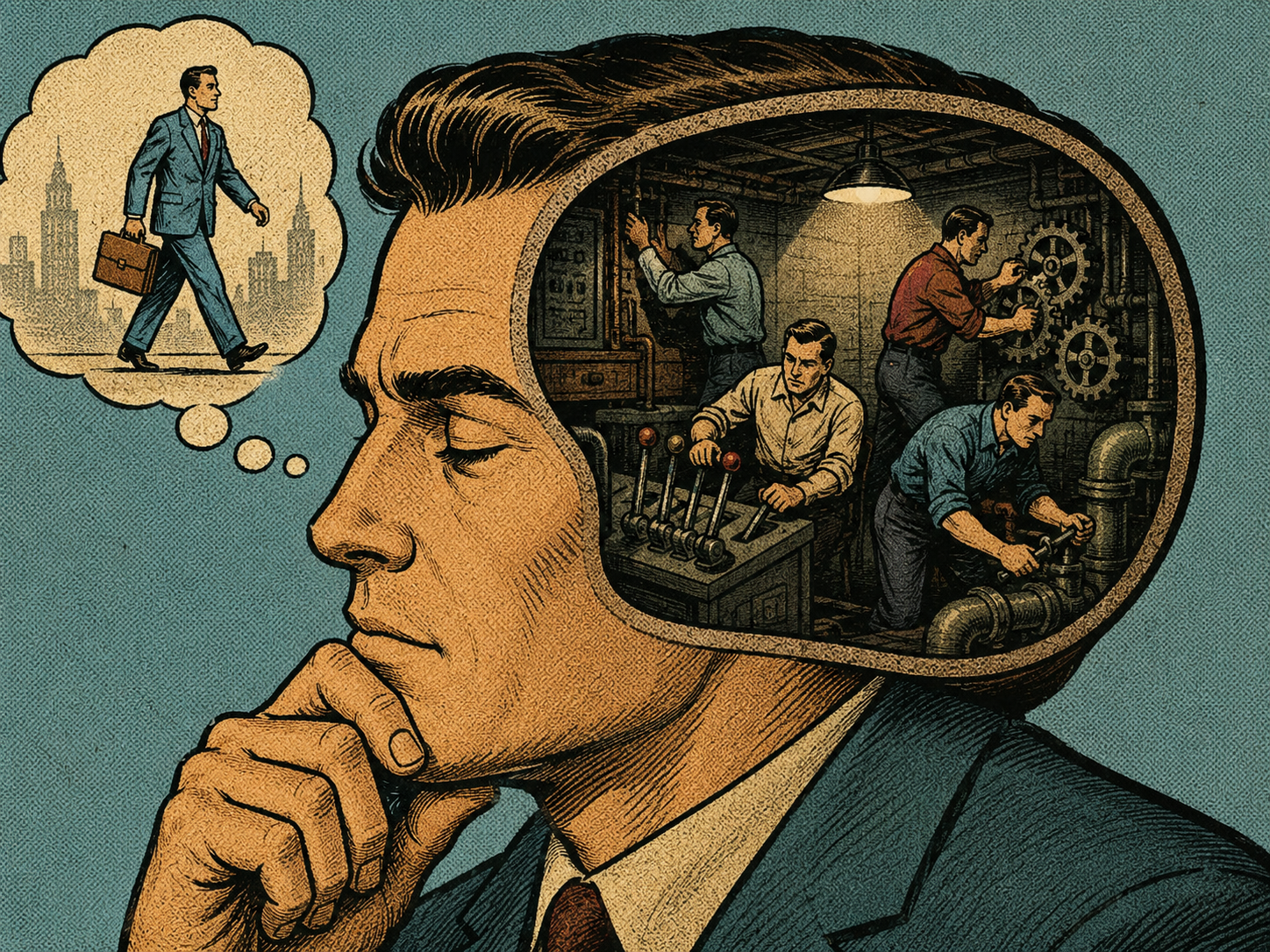
As years pass, these lessons become invisible. They move beneath conscious awareness and begin operating as assumptions.
Eventually they stop feeling like beliefs.
They feel like reality.
The person who learned that people always leave stops seeing distrust as a choice. It becomes common sense. The person who learned that achievement creates worth no longer questions why rest feels uncomfortable. Productivity becomes morality.
The lesson disappears.
Only the behavior remains.
This transformation is what makes personal history so powerful. We do not merely remember our past. We continue living inside conclusions we drew from it.
The Quiet Architecture of Identity
Identity is often described as something we discover.
In practice, much of identity is something we construct.
The construction begins early.
A child learns what earns approval. What creates safety. What attracts criticism. What leads to belonging. These observations become strategies. The strategies become habits. The habits become identity.
Over time, the original purpose is forgotten.
Consider the man who prides himself on being self-reliant.
The trait is celebrated culturally. It sounds admirable. Mature. Strong.
But self-reliance can emerge from very different origins.
It may grow from competence and confidence.
Or it may grow from the belief that depending on others is dangerous.
The behavior looks identical.
The underlying story is completely different.
This is why surface-level self-improvement often produces disappointing results. People try to change behaviors without examining the beliefs sustaining them.
They focus on outcomes while ignoring the architecture underneath.
The result is frustration.
The old pattern returns because the old story remains intact.
Every habit rests on a belief.
Every belief emerged from an interpretation.
Every interpretation began somewhere.
Until that chain is understood, change remains fragile.
The Cost of Unexamined Narratives
Many adults operate from conclusions formed decades earlier.
Some of those conclusions remain useful.
Many do not.
A young athlete may learn that relentless effort creates success. The lesson serves him well through school, sports, and career development.
But the same lesson can become destructive if it evolves into the belief that rest is weakness or that worth depends entirely on performance.
The original insight contained truth.
The expanded conclusion became a trap.
This process occurs everywhere.
A child learns caution after betrayal and becomes incapable of intimacy.
A student learns the value of achievement and becomes unable to stop proving himself.
A teenager learns to avoid conflict and becomes an adult who cannot set boundaries.
The problem is rarely the initial adaptation.
The problem is carrying it beyond the environment that required it.
Strategies designed for survival often become limitations when survival is no longer the challenge.
Yet many people never revisit these conclusions.
They continue operating from outdated assumptions long after circumstances have changed.
The story remains frozen.
Life moves forward.
Tension grows between them.
Why Looking Back Feels Uncomfortable
Some argue that the past should remain in the past. That examining formative experiences encourages excuse-making or endless self-analysis and that’s understandable.
There are forms of reflection that become self-indulgent. There are people who spend years explaining themselves without changing themselves.
But rejecting reflection entirely creates a different problem.
You cannot evaluate beliefs you refuse to examine.
Understanding origin is not the same thing as surrendering responsibility.
In fact, the opposite is true.
Responsibility becomes possible only when hidden influences become visible.
A man who recognizes that his distrust originated somewhere specific gains options. He can decide whether that belief still serves him.
A man who never recognizes it remains controlled by it.
The goal is not to assign blame.
The goal is to gain clarity.
Blame looks backward searching for guilt.
Clarity looks backward searching for understanding.
The distinction changes everything.
One keeps a person trapped in history.
The other allows him to move beyond it.
Becoming the Author Again
Most people think their story is the sequence of events they experienced.
It is not.
Their real story is the meaning they assigned to those events.
That meaning influences decisions, relationships, ambitions, fears, and possibilities. It quietly shapes the future long after the original circumstances have disappeared.
This is why understanding your personal history matters.
Not because the past controls you.
Because neglected interpretations often do.
The task is not to rewrite what happened.
The task is to identify the lessons you absorbed, evaluate whether they remain true, and consciously choose which ones deserve to accompany you into the future.
Every life contains defining chapters.
Every chapter contains lessons.
Every lesson creates consequences.
The people who gain the most freedom are not those with perfect histories.
They are the ones willing to examine the stories they inherited from their experiences and decide which stories still deserve belief.
The past forged part of who you are.
But the meaning you carry forward remains a choice.
And that choice determines far more of the future than most people ever realize.