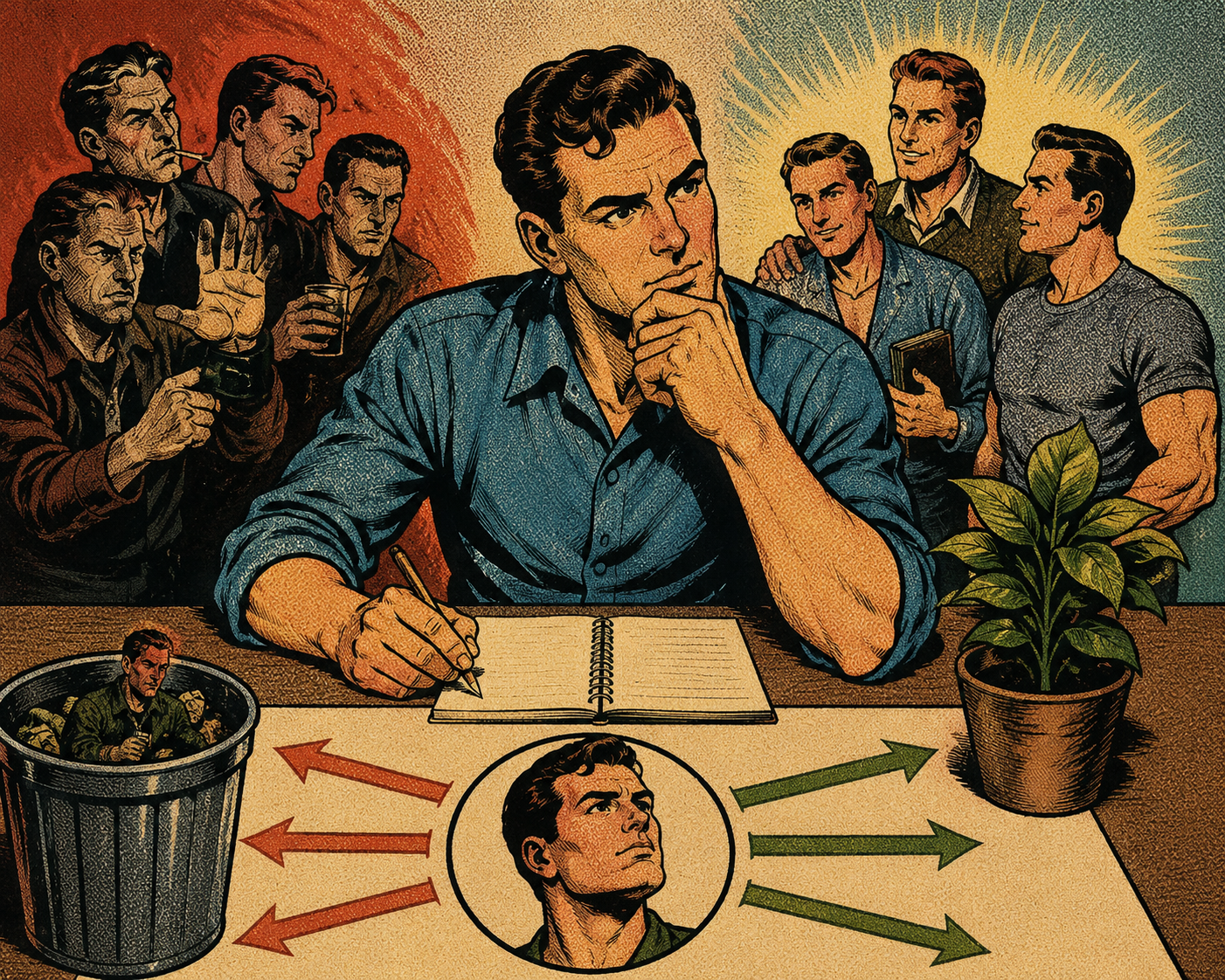
The Company You Keep
He has books on his shelf about discipline. His phone is filled with saved videos about success. He has promised himself that tomorrow will be different more times than he can count. Yet tomorrow often looks suspiciously like yesterday.
His alarm rings. He scrolls before getting out of bed. At work he listens to coworkers complain about people who are more successful than they are. During lunch he joins conversations that revolve around problems no one intends to solve. In the evening he opens social media, watches strangers argue, laughs at jokes that quietly lower his standards, and tells himself he is simply relaxing.
Yet months later he discovers he has become someone he never intended to become.
The remarkable thing about influence is that it rarely announces itself. It arrives without urgency. It asks for no permission. It simply repeats itself until repetition begins to feel like truth.
Most people imagine that personal change is built primarily through individual effort. They assume that stronger discipline, better habits, or greater determination will eventually overcome whatever surrounds them. This belief is comforting because it places every answer inside the individual. It is also incomplete. The environment a person repeatedly inhabits becomes one of the strongest architects of the person they eventually become. Character is not formed only by decisions. It is also formed by proximity and modern life has expanded the definition of close relationships far beyond family, friends, and neighbors.
Today, a person may spend more time listening to a podcast host than speaking to a lifelong friend. A content creator may have greater influence over someone’s values than a parent. A group chat may shape emotional habits more consistently than a weekly conversation with a spouse. The voices surrounding us no longer need to occupy the same room. They only need repeated access to our attention.
The old saying that you become the average of the five people you spend the most time with is useful, but incomplete. Today, the five strongest influences may not even know your name.
Every Forge Produces Its Own Steel
Blacksmiths have long understood something that modern culture often forgets. Steel does not shape itself. It responds to its environment.
Heat changes it.
Pressure changes it.
Repeated blows change it.
Left unattended, even the strongest metal will slowly lose the properties that once made it useful.
Human beings are no different.
Every environment teaches. Every conversation trains. Every relationship establishes a definition of what is normal. When a person repeatedly hears complaints, cynicism becomes reasonable. When excuses become the common language of a social circle, accountability begins to feel unusual. When ambition is mocked often enough, silence becomes safer than aspiration.
This process rarely feels coercive because it usually arrives disguised as belonging.
People naturally adjust themselves to match the expectations of the groups around them. Psychologists have demonstrated this repeatedly through decades of research into conformity and social learning. Individuals routinely alter opinions, behaviors, and even perceptions when surrounded by consistent social pressure. They do not always do so because they are persuaded. Often they simply wish to remain connected.
Belonging is one of humanity’s oldest survival instincts. The danger begins when belonging quietly becomes imitation.
Attention Is the New Neighborhood
Previous generations inherited much of their environment. They lived near the same people, attended the same institutions, and consumed similar information.
Modern life offers something unprecedented.
Nearly everyone now constructs a personal environment through algorithms.
Each click, subscription, and notification slowly assembles a digital neighborhood. The people who occupy that neighborhood become companions of a different kind. They celebrate certain behaviors. They normalize specific beliefs. They reward particular emotional reactions. Whether intentionally or not, they provide an ongoing lesson about what deserves attention.
This matters because attention is never passive.
Attention directs memory.
Memory shapes belief.
Belief guides action.
Action becomes identity.
Many people imagine they are merely consuming information when they are actually rehearsing a way of seeing the world.
The daily news that keeps outrage permanently active. The influencer who convinces every viewer that success should happen immediately. The endless stream of comparison that quietly turns gratitude into dissatisfaction. None of these experiences disappear when the screen turns off. They become part of the mental atmosphere through which every future decision is filtered.
A person who carefully chooses healthy food while consuming unhealthy ideas has misunderstood nutrition.
The mind has a diet as surely as the body does.
Why Loyalty Alone Cannot Guide Relationships
People argue that loyalty requires maintaining relationships regardless of personal cost. Family is family. Old friends deserve permanence. Long histories should outweigh present consequences.
There is wisdom inside this instinct. Commitment matters. Relationships cannot become disposable simply because someone becomes inconvenient. Growth requires patience with imperfect people because everyone is imperfect.
Yet loyalty becomes distorted when it demands the abandonment of responsibility.
There is an important distinction between loving someone and granting unlimited influence over your life.
The first is an act of character.
The second is a decision.
Those decisions deserve examination.
Not every relationship requires distance. Many require healthier boundaries. Some require different conversations. Others simply require spending less time discussing subjects that consistently produce resentment, gossip, or despair. Healthy boundaries are often quiet rather than dramatic. They are less about rejecting people than about protecting direction.
The goal is not to surround yourself with people who always agree with you. Disagreement sharpens thinking. Challenge builds maturity. Honest criticism strengthens character.
The question is simple: Does this relationship consistently move you toward the person you hope to become, or away from him?
Every relationship answers that question through its patterns, not its intentions.
The Quiet Responsibility of Choosing Your Company
Personal responsibility is often described as the willingness to own one’s decisions. Responsibility also includes choosing the conditions under which those decisions will repeatedly be made.
The disciplined person who continually returns to environments built around distraction should not be surprised when discipline becomes exhausting. The ambitious person who spends every evening defending ambition to cynical companions should not wonder why confidence slowly disappears. Human beings possess remarkable resilience, but they are not immune to the influence of repetition.
The people surrounding us become mirrors long before they become advisors.
They reflect what is normal.
They reflect what is possible.
They reflect what deserves pursuit.
Choosing better influences is therefore not an act of arrogance. It is an act of stewardship. It recognizes that identity is never formed in isolation. It is shaped within communities, conversations, routines, and habits that quietly repeat themselves until they become ordinary.
The company a person keeps is not simply a reflection of who they are today.
It is often the clearest prediction of who they will become tomorrow.
This is why the quality of relationships deserves to be examined with the same seriousness as finances, health, or career. Every one of them creates the conditions in which the next version of a person will either emerge or slowly disappear.
The most important relationships in your life may never tell you who to become.
They may never need to.
If they shape what you repeatedly see, repeatedly hear, repeatedly excuse, and repeatedly admire, they have already begun doing the work for you.
The forge is always working.
The only remaining question is whether it is producing the kind of steel you intended to become.