This past weekend, I found myself standing in a hotel bathroom, holding my daughter’s hand under running water while blood moved steadily between my fingers.
We had made this trip many times before.
Every year after visiting my in laws, we break up the drive home with an overnight stop at the same hotel. By that point in the trip, everyone has settled into familiar routines. My job is usually logistical: unload the luggage, set up the pack and play, arrange the noise machine and chargers, make the temporary room feel functional enough for a tired family to land in for the night.
I had just finished setting up the crib transitioning to organizing the electronics when I heard something in the hallway change.
At first it sounded familiar. I hear our nanny call my daughter’s name; they were returning from a short adventure to return the luggage cart to the lobby.
Then I heard the tone.
Parents know this instinctively. There are certain sounds that bypass conscious thought entirely. A shift in someone’s voice can tell you everything before you’ve seen anything at all. I heard fear before I understood why there was fear.
Then I heard my daughter cry.
When I stepped into the hallway, my wife was carrying our daughter toward me. Our nanny, beside them, looked pale and frightened as she held my daughter’s arm high.
My daughter looked confused more than anything else, crying hard in the disoriented way children do when pain arrives too quickly for them to process it.
Then I saw her hand.
Her finger had been caught in a heavy door. Blood ran down across her palm and wrist. The skin at the tip had split and folded in a way that immediately told me this was not something a bandage would solve.
What stands out to me most from that moment was not the injury itself.
It is the transfer of responsibility that happened without discussion.
Nobody asked if I should take her. Nobody paused to decide what came next. My daughter was simply handed to me, and everyone in the hallway instinctively oriented themselves around what I would do next.
Responsibility often arrives that way. Quietly. Automatically. Before you get a say.
I took her into my arms being mindful to continue elevating her hand. My first thought was simple: control the bleeding. I pressed the skin closed with my fingers and tried to assess the damage through the blood.
What came almost immediately afterward was less a though and more an instinct: control the room.
I told my wife the injury was serious enough to require stitches and that she needed to call 911. At the same time, I could see our nanny beginning to panic. Her breathing had become shallow and rapid. She looked frozen between guilt, fear, and helplessness.
Meanwhile, my daughter was staring directly at me through sobs and tears.
Children search adult faces for understanding. They decide how afraid they should be by watching the people around them.
I knew I needed to inspect the wound more carefully, which meant running it under water. But one arm was supporting my daughter while my other hand held pressure against the injury. So before we moved, I stopped and made eye contact with my nanny.
I needed her breathing to slow down first.
“Look at me,” I told her calmly. “I need you to turn on the faucet.”
That moment has stayed with me because I realized later that leadership in crisis is often less about giving orders than regulating emotional momentum. Panic spreads quickly through groups. So does calm.
Once the water was running, I shifted my attention back to my daughter.
“Look at me,” I told her. “This might hurt a little.”
Then I explained everything before it happened.
I told her when the water would touch her finger. I told her why we needed to look at it. I told her we were going to get help. I told her what would happen next before it happened next.
Looking back, I think that instinct mattered as much as anything else I did that night.
Fear grows fastest inside uncertainty.
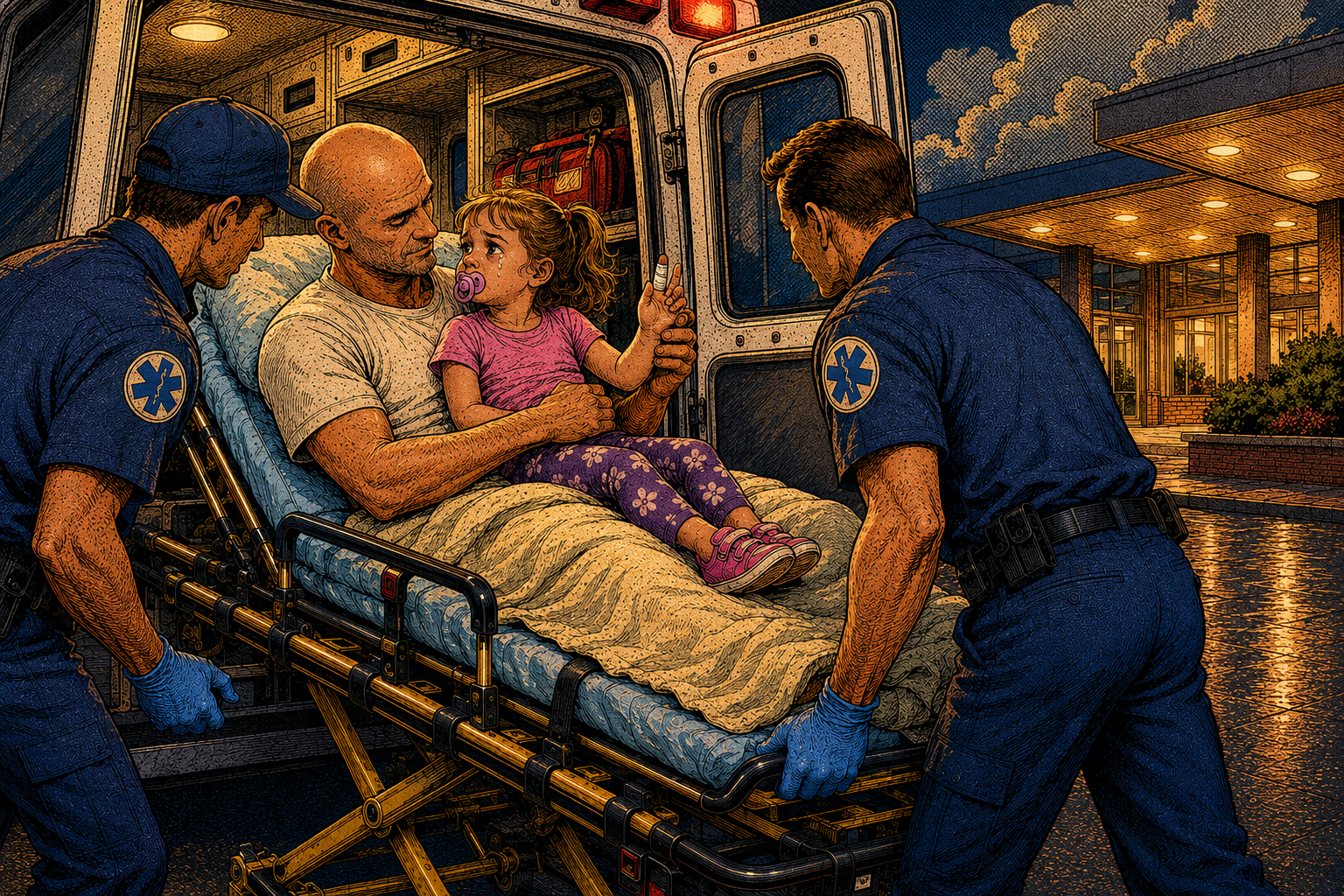
The ambulance ride followed the same rhythm. The sirens, the radio chatter, the bright lights, the movement of strangers around her, all of it could have become overwhelming. So I narrated the experience before it reached her.
I told her what the sounds were.
I told her what the ambulance workers were doing.
I coached her breathing using a trick from one of her children’s books: smell the flowers, blow out the candles. Slow inhale through the nose. Slow exhale through the mouth.
Whenever her pain or fear spiked, I offered her my finger to squeeze.
At the hospital we learned the injury was worse than we initially thought. The bone in her finger had fractured. She would need a pediatric hand specialist at another facility.
By then the bleeding was controlled and a numbing agent had been applied. My daughter was calmer, distracted by one of her favorite shows on a tablet my wife wisely thought to bring out.
We transferred hospitals. We answered questions. We signed forms. We waited.
Eventually the specialist was ready to repair the finger.
That was the first moment I truly saw the extent of the injury.
The surgeon irrigated the wound while nurses prepared instruments and medical solutions. A child life specialist stood nearby with toys and books redirecting my daughter’s attention as needed. Everyone in the room moved with quiet precision. Nobody appeared hurried. Nobody raised their voice. Each person had a role. Each person trusted the others to perform theirs.
What struck me most was how calm competence changes the emotional temperature of a room.
Not because anyone denied the seriousness of what was happening. The seriousness was obvious. My wife and nanny both had moments where emotion visibly overtook them while being in proximity to the repair. Even I felt waves of it internally.
But somebody still needed to remain steady enough to translate the moment for everyone else.
Fear was present the entire night.
It simply could not become the loudest thing in the room.
The surgery ultimately went well. The surgeon was hopeful, although it is still too early to know whether my daughter will fully retain the tip of her finger.
Now that we are home again, I keep thinking less about the injury itself and more about who I was called to be during those hours.
Not because I did anything extraordinary.
Most of what I did was simple.
Lower your voice.
Simplify the next step.
Regulate yourself first so others can regulate around you.
Explain what is happening before it happens.
Reduce uncertainty whenever possible.
What I realized afterward is that these are not emergency skills. They are life skills that reveal themselves during emergencies.
People often imagine leadership as something dramatic, a trait that emerges spontaneously in high stakes moments. But I no longer think that is true. I think most crisis behavior is rehearsed long before the crisis arrives.
You practice steadiness in ordinary conversations.
You practice responsibility in small daily inconveniences.
You practice emotional regulation when the stakes are low, when nobody is bleeding, when nobody is panicking, when nobody urgently needs you to become calm.
Then one day, without warning, people turn toward you.
That is the moment most men misunderstand.
They think leadership begins there.
It does not.
The emergency only reveals what has already been built.
A man who cannot regulate himself during ordinary frustration will struggle to regulate himself during real fear. A man who panics during inconvenience will panic harder when consequences become serious. A man who avoids responsibility in small moments will feel crushed when responsibility arrives all at once.
Pressure rarely creates character on the spot.
More often, it exposes the structure that was already there.
That is why calm leadership looks simple from the outside. The voice stays low because steadiness has been practiced before. The thinking stays narrow because panic has been managed before. The next action becomes clear because responsibility has already become familiar.
Control the bleeding.
Call 911.
Turn on the faucet.
Explain what happens next.
One step at a time.
Most people lose themselves because their mind races too far ahead. They try to emotionally solve outcomes they cannot yet control. Fear expands inside uncertainty until it fills the entire room internally.
Strong leadership interrupts that expansion.
Not through pretending nothing is wrong.
Not through emotional shutdown.
Through structure.
Here is what is happening.
Here is what we are doing.
Here is the next step.
That is what steadiness actually is.
Not the absence of fear.
The ability to keep fear from becoming the loudest thing in the room.
You may not get to choose when you are called on to lead. You may not get time to prepare yourself emotionally for the moment responsibility arrives. In many cases, the moment chooses you first.
And when it does, you fall back on what you have practiced.
I keep returning to a thought that is ultimately what I want to anchor this with today: choose responsibility daily.
Not because it guarantees control over difficult outcomes. It does not.
Not because fear disappears. It will not.
But because the habits you build in ordinary moments eventually become the instincts you rely on when someone else needs steadiness from you most.
Keep your voice low and your words simple.
Name the next action.
Tell people what you will do and what they should do.
Prepare people for what is coming.
In difficult moments, calm leadership is rarely dramatic.
More often, it is quiet, direct, and practiced long before the emergency arrives.
You can continue reacting emotionally every time pressure enters the room. You can keep letting stress control your tone, your thinking, and your decisions. That path slowly weakens trust in yourself and in the people depending on you.
Or you can build steadiness before life demands it from you. You can practice calm during ordinary moments so that when real pressure arrives, your response is already trained. You can become the person who lowers the emotional temperature instead of raising it.
One path keeps repeating panic.
The other builds quiet strength people can rely on.