The Page Beside the Coffee Mug
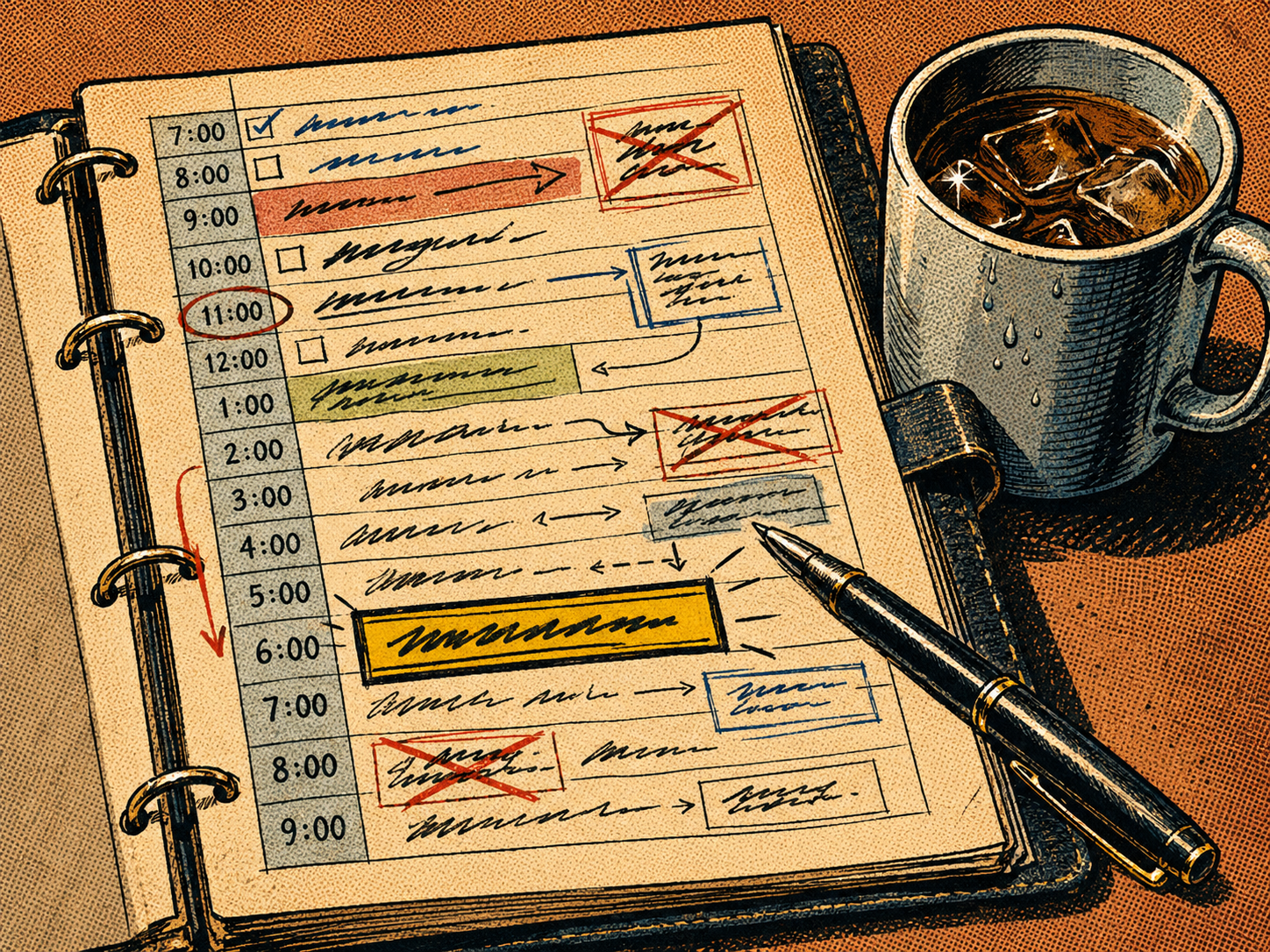
A paper calendar sat beside a cold coffee mug on the corner of a workbench. Most of the page was empty. There were two meetings written in blue ink, a doctor’s appointment near the bottom, and a small note about picking up groceries. The rest of the day had been left open.
At first, the blank space looked like freedom.
By noon, it was gone.
A phone call ran long. Three emails became twenty. A small repair took an hour. Lunch happened over the sink. The workout was moved to the evening, then dropped when work ran late. Dinner came later than planned. The final hour of the night disappeared into a phone because there was no energy left for anything that required thought.
Nothing terrible happened.
That is part of the problem.
The day did not collapse. It simply filled itself.
I think many days are lost this way. Not through one major mistake, but through a series of small claims on time that were never challenged. Each request seems reasonable. Each delay seems temporary. Each distraction seems too small to matter.
Then the day ends, and the things that mattered most are still waiting.
The Difference Between Open and Unclaimed
An open hour and an unclaimed hour are not the same thing.
An open hour has been left available on purpose. It may be used for rest, family, thought, or whatever the day requires. It has a role.
An unclaimed hour has no defense.
It will usually be taken by whatever arrives first.
This is where things become strange. We often believe that refusing to plan gives us more control. We do not want to feel trapped by a schedule. We want room to respond to life. We tell ourselves we will handle the important things when the right moment appears.
But the right moment has to compete with every easier action.
The phone is easier than the workout. Email is easier than focused work. Another small task is easier than the hard task that requires a clear mind. Staying up late is easier than ending the night with discipline.
Attention follows the easiest path.
Without a plan, the day does not remain free. It becomes available to interruption.
That distinction matters because many men are not failing from a lack of effort. They are working. They are carrying real duties. They are solving problems. They are helping people. Their days are full.
The issue is that fullness and direction are not the same thing.
A furnace can hold a great deal of heat. But if the heat has no direction, it burns fuel without producing useful work. The problem is not the fire. The problem is containment.
A day works the same way.
Why Good Intentions Keep Losing
Most people know what matters to them.
They know sleep matters. They know exercise matters. They know focused work matters. They know family matters. They know there are calls they should make, skills they should build, and tasks they should stop avoiding.
The knowledge is rarely missing.
The time is missing.
More precisely, the protected time is missing.
A man may say his health is important, but his workout has no place in the day. He may say his family comes first, but family time begins only after every other demand is finished. He may care about building a business, learning a trade, or managing his money, but those goals receive whatever energy survives the workday.
Usually, not much survives.
Habits remember what intentions forget.
This is why a calendar can tell the truth in a way that values alone cannot. A value tells you what matters. A schedule shows whether it has been given room to exist.
I want to be careful here. A full calendar does not prove a good life. A man can schedule every minute and still avoid what matters. He can use structure to stay busy, hide from hard choices, or turn his life into a set of tasks.
The smaller claim is actually more useful.
What matters must receive time, or something else will receive it.
That is not a theory about productivity. It is a plain fact about daily life.
The workout needs an hour. The conversation needs twenty minutes. The report needs a clear morning. Dinner needs more than the few minutes left between work and exhaustion. Sleep requires an ending to the day.
Nothing happens outside of time.
A Schedule Is a Form of Containment
Fire needs direction.
The Furnace gives it containment.
The Forge turns that contained heat into useful change.
A daily schedule belongs in the middle of that process. It does not create your purpose. It does not decide what kind of man you should become. It does not supply discipline on its own.
It holds your energy long enough for it to become action.
That is why structure often feels less exciting than motivation. Motivation gives a quick rise in heat. Structure asks where that heat will go at 7:00 tomorrow morning.
Motivation says you should exercise.
Structure puts the shoes by the door and gives the workout a start time.
Motivation says the project matters.
Structure closes email and protects ninety minutes for the first hard step.
Motivation says family comes first.
Structure ends work at a real hour and gives the evening a boundary.
The fire may begin the movement. The Furnace keeps it from escaping.
This matters because pressure is not always the enemy. A man may have plenty of pressure. Bills are due. Work is demanding. People rely on him. Goals remain unfinished. The problem is often that the pressure enters every part of the day at once.
Everything feels active.
Nothing feels complete.
A schedule gives pressure a path. It decides which demand belongs now and which demand must wait.
That simple choice reduces waste.
The Hours Are Not Equal
There is another mistake hidden inside many plans. We treat every hour as if it carries the same strength.
It does not.
There are hours when your mind is clear. There are hours when your body is ready to move. There are hours when you can solve a hard problem without forcing every thought. There are other hours when even a small task feels heavy.
A useful schedule respects this without becoming ruled by it.
If your clearest hour is early in the morning, it should not be given away to messages that could be answered later. If your energy falls after lunch, that may not be the best time for your hardest decision. If your patience is low at the end of the workday, you may need a short pause before entering the house and carrying that strain into dinner.
What I have started noticing is that poor timing often looks like weak character.
A man tries to write late at night after a full day and decides he lacks focus. He plans to train after an unpredictable work shift and decides he lacks discipline. He schedules a hard talk during the most rushed part of the evening and decides the relationship is the problem.
Sometimes those conclusions are true.
Often, the first problem is simpler.
The task was placed where it had little chance to succeed.
The Furnace does not only contain heat. It controls where the heat goes and how long it stays there. A day needs the same care.
Hard work should meet strong hours.
Light work can meet weaker ones.
Rest should arrive before the system breaks, not after.
Why Perfect Plans Fail
The first version of a schedule often looks impressive.
It begins early. It includes exercise, reading, focused work, healthy meals, family time, chores, planning, and a proper bedtime. Every hour has purpose.
Then real life enters.
The commute takes longer. A child cannot find a shoe. A meeting runs over. Dinner takes more time than expected. The task that looked simple requires another hour. The schedule begins to slide, and by evening it feels useless.
The usual response is to blame structure.
“I am not a schedule person.”
That may be true in the same way a man who has never trained is not a training person.
The first failure does not settle the matter.
It gives information.
A schedule is not a promise that the day will obey you. It is a test of how the day actually works.
This is where many people become too harsh or too loose.
The harsh man treats every delay as failure. He tries to force the plan long after it has stopped matching reality. He steals from sleep to recover every missed task. The schedule becomes brittle.
The loose man treats every delay as permission. One interruption appears, and the rest of the plan is abandoned. The schedule becomes decoration.
Both miss the purpose.
Structure should bend without disappearing.
A late meeting may require moving email, not removing family dinner. A short night may require a lighter workout, not no movement at all. An urgent repair may take the evening, but it does not need to take tomorrow morning too.
The point is not to protect every block.
The point is to protect what matters most.
What the Schedule Reveals
A written day does more than organize time. It reveals where your life leaks.
You may discover that your morning is not short. It is being spent on your phone.
You may discover that work does not always require the entire evening. It expands because you never decide when it ends.
You may discover that exercise is not impossible. It is placed in the least reliable part of the day.
You may discover that you are not too busy to read, plan, or call someone you care about. You are spending those minutes in ways you do not remember.
I am not convinced every problem can be fixed by better scheduling. Some lives are carrying more weight than a clean calendar can solve. A second job, a sick parent, a new child, a hard season at work, or money trouble can leave little room.
But even then, structure becomes more important, not less.
When time is tight, unplanned waste costs more.
The obvious question becomes: what can a schedule truly change?
It can make your priorities visible.
It can expose false time estimates.
It can show which interruptions are real and which ones you keep allowing.
It can reveal when your energy is strongest.
It can force a choice between what you claim matters and what repeatedly receives your hours.
That is enough to begin.
Identity Quietly Keeps Score
A man does not become disciplined because he writes a disciplined plan.
He becomes disciplined when his behavior begins to match the plan often enough to create proof.
The first morning he starts the hard task before checking messages, the change is small.
The third time, it becomes a pattern.
After several weeks, it becomes a way of working.
Repetition builds identity because identity quietly keeps score.
You remember whether you keep your word to yourself. You remember whether the workout happens only when the day is easy. You remember whether family receives full attention or the tired part left after work. You remember whether bedtime is a real boundary or a suggestion.
This record may never be written down, but it shapes what you believe about yourself.
Integrity is structural.
It is easier to keep a promise when the promise has a time, place, and boundary. It is harder when the promise must compete with every demand in the day.
This is why people often do not need stronger motivation. They need an environment that protects the motivation they already have.
The schedule is part of that environment.
It is not the whole Forge. But it gives the hammer somewhere to land.
The Choice Hidden in an Ordinary Day
By evening, the paper calendar beside the coffee mug no longer looked empty.
The owner had added several notes.
The morning work block needed another thirty minutes. Lunch had to be prepared the night before. The gym worked better before the commute. One meeting needed a buffer. The phone had taken more time than any urgent task.
The page had become less neat.
It had also become more true.
That may be the real work of scheduling. Not creating a clean picture of an ideal man, but building a usable structure for the man who must wake up tomorrow and live the day.
Fire gives direction.
The Furnace protects that direction from waste.
The Forge turns it into something visible.
A schedule is where that movement becomes ordinary. It is where purpose meets 8:00 in the morning. It is where values meet a crowded afternoon. It is where the man you intend to become meets the next block of time.
The day will be filled either way.
The choice is whether you will give it shape before someone else does.
Build Tomorrow Before It Arrives
Name what must fit. Write every fixed duty, real need, and important priority from waking to sleep. Include travel, meals, rest, and preparation.
Give each priority a time. Place hard work in your strongest hours. Add clear start times, end times, and enough space for real life.
Test and correct the plan. Follow it for one day. Record where it broke, keep what worked, and change one thing before the next morning.
The blank page beside the coffee mug is not freedom by itself.
It is unclaimed time.
You can leave it open and let the day decide what enters.
Or you can decide what deserves to be there, then accept responsibility for protecting it.