The Calendar on the Kitchen Counter
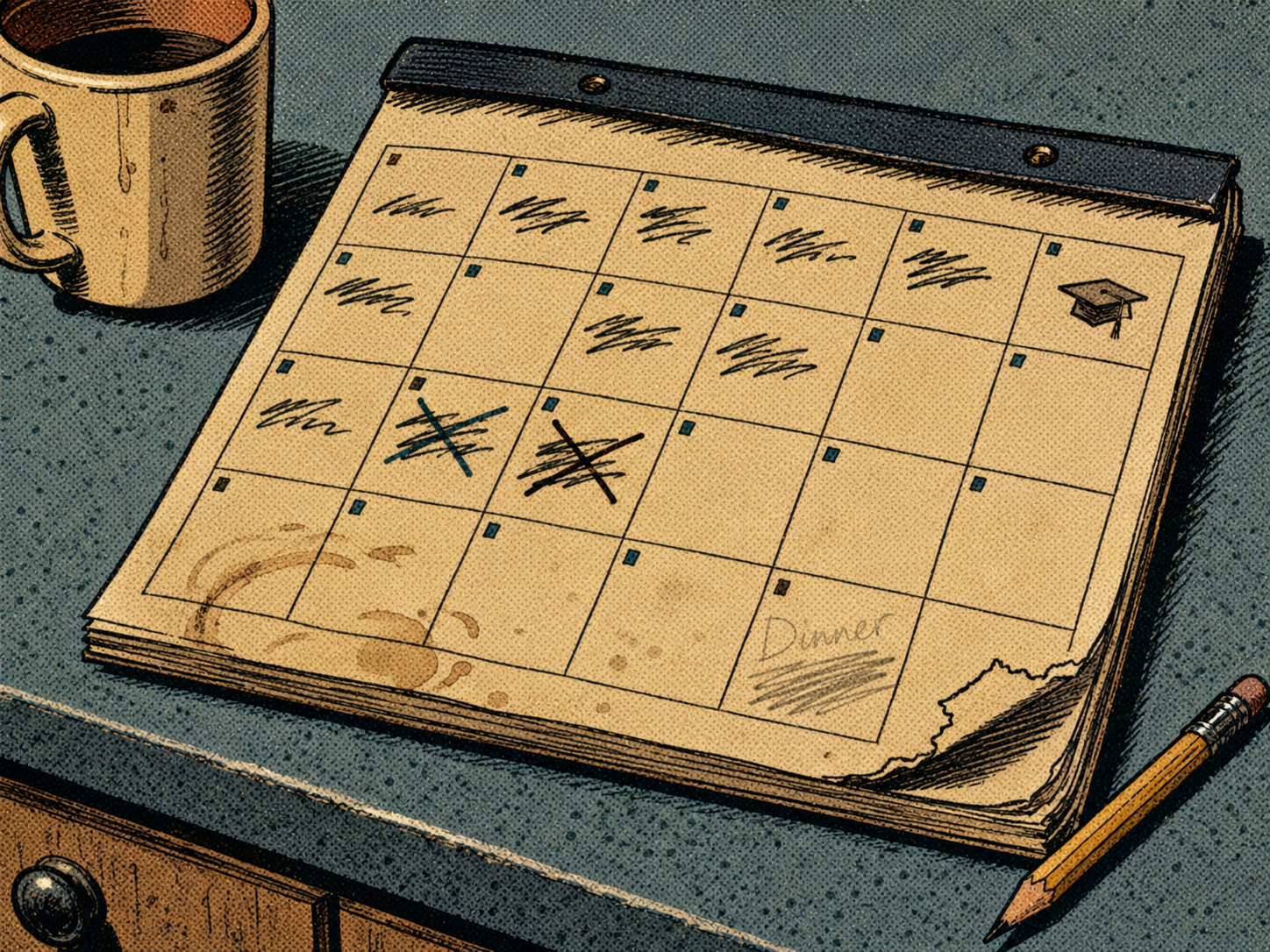
There was a paper calendar on the kitchen counter. It had coffee marks near the bottom and a torn corner from being moved too many times. Work meetings filled most of the squares. A school event sat in one corner. A doctor’s visit had been crossed out twice. Friday night had the word “Dinner” written in pencil, then erased.
Nothing on the page looked dramatic.
That was the problem.
The calendar did not show a man in crisis. It showed a man doing what had to be done. He was working. Paying bills. Taking calls. Solving problems. Keeping things moving.
But the page told another story too.
The parts of life that shouted the loudest had taken the most space. The parts that mattered but stayed quiet had been pushed aside. Health could wait. A long talk with his wife could wait. Sleep could wait. Friends could wait. Rest could wait.
The calendar had become a record of delay.
I think this is how imbalance usually enters a life. It does not break down the front door. It does not announce itself. It starts as a small trade. One late night. One missed meal. One more week without training. One more call answered during dinner.
Each choice makes sense by itself.
Together, they build a life.
The Roles That Never Stop Asking
A man carries many roles at once.
He may be a worker, husband, father, son, friend, leader, provider, neighbor, and student of his own craft. Each role asks something from him. Time. Energy. Attention. Patience. Money. Presence.
The trouble is that these roles do not ask in equal ways.
Work sends alerts. Children ask out loud. Bills come with dates. A tired body is quieter. A distant friendship may say nothing. A marriage can remain polite while becoming thin.
Attention follows the easiest path. It also follows the loudest demand.
That is why a man can give most of his life to one role without making a clear choice to do so. He may believe he is serving the whole family through work. He may believe he will return to his health when things calm down. He may believe people understand why he is absent.
For a while, they may.
But habits remember what intentions forget.
The body remembers missed sleep. A child remembers who was present. A marriage remembers what received the best hours. A man’s own mind remembers every promise he made and did not keep.
This is not about making every part of life equal. Equal time is rarely possible. A newborn changes the week. A hard season at work changes the month. Illness changes the year.
Balance is not equal weight.
Balance is correct weight.
When Strength Becomes Distortion
Here is the interesting part.
The role that takes too much is often not a bad role.
Work is good. Providing is good. Training is good. Helping family is good. Building a business is good. Serving others is good.
But a good role can grow past its proper size.
A man may use work to provide, then slowly use work to avoid. He may help everyone around him, then leave no strength for the people closest to him. He may train his body with discipline while neglecting the conversations that require more courage than a workout.
The first sign is often not failure.
It is success in one area and weakness in another.
The career grows while the body slows down. The bills get paid while the marriage becomes a set of shared tasks. The house stays running while no one inside it feels known.
This is where things become strange. The man may receive praise for the very pattern that is costing him his life. People call him driven. Reliable. Tireless. Strong.
He may be all of those things.
He may also be badly out of balance.
A furnace can hold great heat, but only if the heat stays inside the right walls. When one part cracks, energy moves where it should not go. The fire still burns. The system still runs. But damage begins beneath the surface.
A life works in much the same way.
Pressure needs a path. Roles give it one. But when one role takes every path, effort begins to leak.
The Quiet Cost of Neglect
Neglect does not always look like laziness.
Sometimes it looks like postponing what cannot force its way onto the schedule.
A man skips one workout because he has a deadline. Then another. He stops calling a friend because the week is full. He tells his wife they will plan time together after the busy season. He stays up late because night is the only time that feels like his own.
None of these choices destroys a life.
But repeated choices become structure.
Before going further, I want to be careful here. The smaller claim is actually more interesting. The problem is not that a man works hard. The problem is that he may stop checking what his hard work is producing.
Effort can build one thing while eroding another.
The test is visible.
What is stronger because of the way you live?
What is weaker?
Look at ordinary proof. Your sleep. Your patience. Your bank account. Your strength. Your closest relationships. Your unfinished promises. The state of the rooms you use. The people you keep delaying.
These are not moral scores.
They are evidence.
Failure is usually structural and traceable. So is neglect.
A man may say family matters most, but his calendar may show that work gets his sharpest hours. He may say health is a priority, but his week may contain no time for sleep, movement, or food he chose on purpose.
The mind quietly assumes that what matters will somehow survive without attention.
It often does not.
Balance Is a Form of Honesty
Balance begins when a man stops asking whether he is busy and starts asking whether his effort is placed correctly.
That question can be uncomfortable because it removes the comfort of good intentions.
It asks him to look at his roles one by one.
Not the life he hopes to build. The life he is building now.
He may find that one role is carrying too little weight. Health has been left behind. Marriage has become maintenance. Friendship has disappeared. Faith has become an idea instead of a practice.
He may also find that one role is carrying too much. Work is entering every room. His phone is breaking every quiet moment. Other people’s needs are taking the place of his own duties. A side project is consuming the time meant for recovery.
This is not solved by guilt.
It is solved by correction.
A furnace does not become useful because the fire feels intense. It becomes useful because the heat is held, directed, and used on purpose.
The same is true of attention.
Motivation is not the main problem. Most men already care about their health, family, work, and future. What they lack is a structure that protects those things from each other.
Without structure, the loudest role wins.
With structure, each role has a place.
The Work of Setting Limits
Now the obvious question becomes: what does correction look like?
It rarely begins with a large life change.
It begins with one limit.
No work email after seven. Phone outside the bedroom. One evening kept clear. One appointment placed back on the calendar. One call made before the month disappears. One meal eaten without a screen.
These choices look small because they are small.
That is why they work.
A boundary is not a speech about what matters. It is a rule that protects what matters when pressure arrives.
Without a rule, the ego bargains.
Just one more email. One more hour. One more task. One more week.
The bargain always sounds reasonable.
Then the calendar fills again.
I think there is a distinction worth making. A boundary does not mean the oversized role is unimportant. It means the role is important enough to be kept in its proper place.
Work that takes everything will not remain good work. Service that destroys the servant will not remain useful. Discipline that leaves no room for recovery will become damage.
Strength needs shape.
That is the work of the furnace. It contains the fire so the forge can use it.
What the Week Reveals
A single week can tell you more than a long promise.
Choose one neglected role and give it one visible action. Choose one overused role and give it one clear limit. Then watch what changes.
You may notice that one walk after dinner gives you more patience than another hour online. You may notice that leaving work on time does not cause the collapse you feared. You may notice that one quiet meal creates a better conversation than a long speech about being present.
You may also notice resistance.
The phone will feel urgent. Work will produce one more demand. The old habit will argue that this week is different.
That resistance is useful.
It shows where the imbalance has become normal.
Identity quietly keeps score. Every time you keep the boundary, you become more believable to yourself. Every time you complete the neglected action, you place weight back where it belongs.
Repetition builds identity because repeated action is evidence.
A man does not become balanced by describing balance well.
He becomes balanced by correcting his week.
Put the Weight Back Where It Belongs
The paper calendar on the kitchen counter still has the same squares.
Work still needs to be done. Bills still arrive. People still need help. Life does not become quiet because a man decides to live with greater care.
But one square can change.
The doctor’s visit can stay on the page. Dinner can be written in ink. The evening can remain open. The phone can be placed in another room.
The calendar is not just a planning tool.
It is a record of what receives your life.
That is why the choice is not between ambition and balance. The real choice is between effort that serves the whole life and effort that slowly steals from it.
Make the correction visible.
Map the roles. Write down the main roles you carry and score each one from 1 to 10 using current behavior as proof.
Shift the weight. Choose one neglected role to feed and one oversized role to restrain with a clear boundary.
Place it in time. Schedule the action, schedule the limit, and review the result at the end of the week.
You can keep letting the loudest role write the calendar.
Or you can decide what deserves the weight of your life.