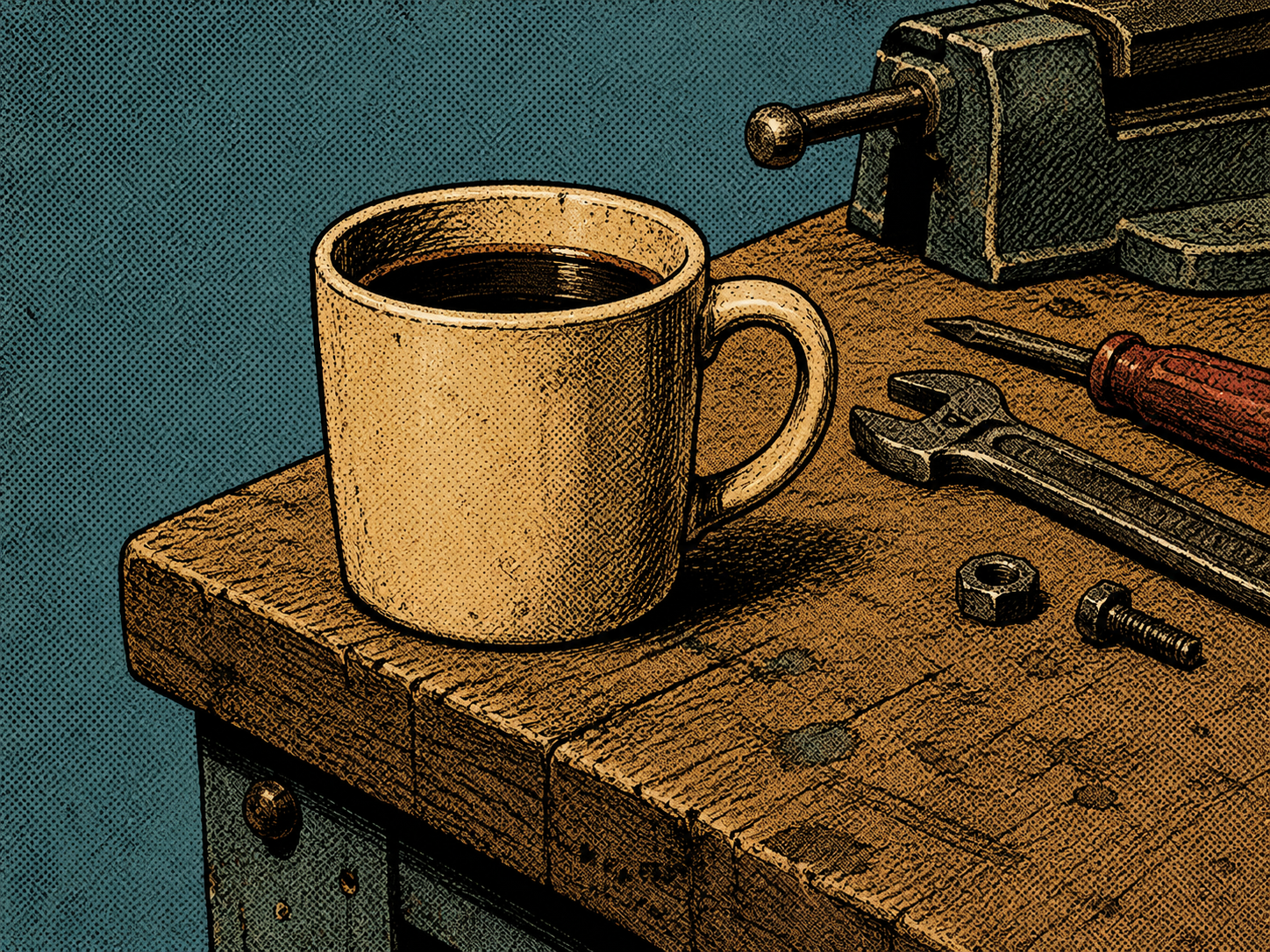
A coffee mug sat on the corner of the workbench for three weeks.
Every morning it was there. Cold. Half full. A brown ring had formed inside where the coffee dried a little more each day. The mug became invisible because it never moved. The man using the bench still noticed the projects spread across the table. He noticed the deadlines. He noticed the tools he needed. He never noticed the mug until he finally picked it up.
The stain surprised him.
The weight surprised him.
The smell surprised him.
Nothing dramatic had happened. One small thing had simply stayed in place long enough to become part of the background.
I think that happens far more often than we realize.
Most people imagine change arriving through a major decision. A new job. A better routine. A breakthrough conversation. A big goal finally achieved. Those moments matter, but they are rare. Most of life is shaped by the things that quietly become normal. The messy desk. The phone beside the bed. The friend who always drains your energy. The promise you keep postponing until next Monday.
The strange part is that familiarity hides almost everything.
Your eyes stop seeing what your life keeps repeating.
Here’s the interesting part.
The human mind is remarkably good at adapting. That ability keeps us alive. We adjust to cold weather, loud streets, busy schedules, and difficult seasons. The same ability also creates a problem. We adapt to habits that slowly work against us. After enough repetition, the habit no longer feels like a choice. It feels like reality.
A cluttered room starts feeling normal.
Constant distraction starts feeling normal.
Living tired starts feeling normal.
Putting important conversations off starts feeling normal.
The condition becomes invisible because it has remained unchanged for too long.
I want to be careful here because this explains only one small part of why people stay stuck. Life is complicated. People carry real burdens. Circumstances differ. Still, I keep noticing that many frustrations survive because they quietly blend into the landscape.
The obvious problem rarely stays the real problem.
Missing one workout is rarely about exercise.
Ignoring your budget is rarely about money.
Scrolling for another hour is rarely about entertainment.
Each visible action usually points toward something underneath. Attention has settled into an easy path. Habits remember what your intentions forgot. The environment quietly teaches you what to repeat.
That matters because people often respond by demanding more effort from themselves.
They promise to work harder.
Wake earlier.
Become more disciplined.
Try again on Monday.
Sometimes that works for a while. Heat can produce movement. A burst of determination feels powerful because it creates action immediately.
But heat alone burns fast.
Anyone who has built a campfire knows this. Dry wood catches quickly. Without anything containing that fire, it burns through its fuel and leaves ash behind. The fire itself was never the problem. The way it was contained determined whether it lasted.
Life works much the same way.
Direction gives you somewhere to go.
Structure keeps you moving after the excitement fades.
Eventually your work becomes useful beyond yourself.
Those three parts quietly support each other.
Without direction, effort scatters.
Without structure, energy leaks.
Without useful work, progress feels empty because nothing outside you changes.
I think many people mistake exhaustion for commitment. They stay busy every hour of the day yet cannot explain why they remain in the same place six months later. Activity creates the appearance of progress. Repeated movement without adjustment simply digs a deeper groove.
This is where things become strange.
The longer something exists in your life, the more permission it quietly receives.
The unopened books.
The unfinished project.
The broken sleep schedule.
The constant interruptions.
The relationship that leaves you smaller every week.
The belief that says, “This is just who I am.”
Each one slowly earns permanent residence because nothing interrupts it.
Identity begins keeping score.
Not through what you say.
Through what survives every ordinary Tuesday.
I think this is why honest reflection feels uncomfortable. Reflection forces ordinary things back into view. You begin seeing the mug on the corner of the workbench again. You notice what has quietly collected around your life while your attention stayed somewhere else.
Some discoveries feel encouraging.
You realize a simple habit has strengthened your character more than you expected.
A conversation repaired more than you knew.
A daily walk restored clarity.
Small actions compound quietly in both directions.
Other discoveries feel heavier.
You realize your mornings always begin with distraction.
Your evenings always end with avoidance.
Your calendar reflects obligations you never consciously accepted.
Your environment has been making important decisions for you.
None of these observations are reasons for shame.
They are evidence.
Evidence gives you something solid to work with.
Before going further, I think there is a distinction worth making.
Accountability is different from self criticism.
Self criticism keeps asking why you became this way.
Accountability asks what keeps repeating.
One looks backward searching for blame.
The other looks forward searching for leverage.
That smaller question usually creates larger change.
What keeps repeating?
Which parts of your life quietly support the man you want to become?
Which parts quietly work against him?
Once those answers become visible, change stops feeling mysterious. The path rarely requires becoming someone entirely different. More often, it requires removing what quietly steals energy and protecting what quietly creates it.
That process feels ordinary because it is ordinary.
You clean the workspace.
Move the phone.
Change the schedule.
Set a boundary.
Keep a promise.
Repeat tomorrow.
The individual actions seem almost too small to matter. Weeks later they begin shaping a different life because repetition always writes a stronger story than intention.
Now the obvious question is what to do next.
Keep it simple.
First, review your life honestly. Look backward without defending yourself. Find the patterns that keep appearing. Notice the changes you’ve already made, along with the ones you’ve delayed. Choose the three improvements that would create the greatest difference if they became permanent.
Second, write those improvements into clear commitments. Give each one a visible rule that can be followed. Vague hopes disappear under pressure. Specific actions survive ordinary days because they tell you exactly what comes next.
Third, begin immediately and keep track. Place reminders where you will see them. Tell someone who will expect follow through. Adjust as you learn, but never leave the commitment trapped inside your head. Action gives truth somewhere to live.
The choice is simple, even if carrying it out will take time.
You can allow familiar problems to disappear into the background until they become permanent parts of your life.
Or you can pick up the mug sitting quietly on the corner of the workbench.
You may be surprised by what has collected there.
You may also discover that the smallest things you choose to clean, protect, and repeat become the foundation for everything that follows.