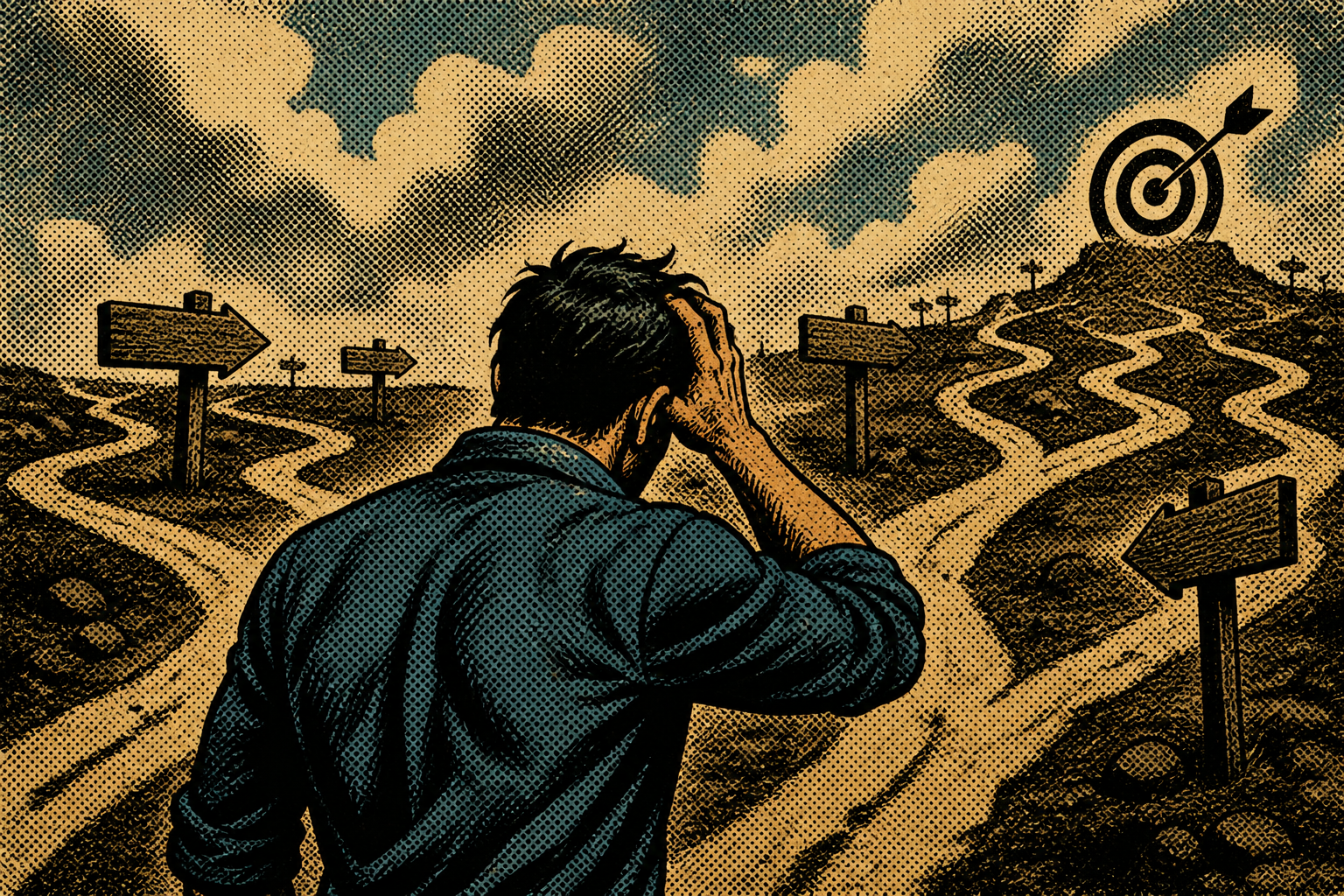
The Man Who Never Gets Angry
He sits at the table and listens. The conversation has been civil enough to pass as ordinary, which is part of the problem. Then someone makes a remark with just enough edge to cut and just enough ambiguity to deny the blade. He hears it; his shoulders move a fraction before he nods and says, “I hear you.”
Later, when someone asks whether the comment bothered him, he gives the answer men often give when they have learned to distrust their own heat. “I’m fine,” he says. “Just thinking.”
He believes this. That is why the answer is so hard to challenge.
The feeling has not vanished. It has gone underground. It becomes a clipped reply the next morning, a slower text, an unexplained reluctance to be in the same room. By the time he notices the change in himself, the original incident feels too small to mention. A grown man does not want to say that a sentence at dinner has been sitting in his chest for two days.
So he says nothing. The room remains peaceful. The relationship quietly absorbs another unpaid debt.
This is the strange success of the man who never gets angry. He avoids the visible failure and inherits the hidden one. He does not shout. He does not throw his weight around. He does not make everyone else manage his mood. Yet the anger he refuses to identify keeps acting on his behalf, often with less fairness than he would have shown if he had spoken plainly at the start.
Calm Can Be a Disguise
American culture has become fluent in the language of regulation. We praise composure, restraint, emotional intelligence, and nervous-system control. Much of that praise is deserved. No marriage, company, team, or friendship is improved by people who treat every irritation as a summons to perform their injury in public.
Still, a confusion has settled in. We have begun to treat the absence of visible anger as proof of maturity. For many men, especially, the assignment is clear. Stay even. Do not be reactive. Keep your voice low. Prove that you are safe.
That bargain has a cost. Anger is among the body’s most useful forms of information. It tells a person that a boundary has been crossed, an expectation has been violated, or a risk has entered the room. The signal can be crude, wrong, or louder than the facts deserve. Even so, it carries data that a person needs in order to judge his situation accurately.
The man with no access to that signal is easier to be around in the short term. He may also be easier to mislead, overwork, interrupt, shame, or slowly estrange. His politeness begins to function as a liability. Everyone else learns where the line is only after he has disappeared behind it.
How Men Learn to Misread Themselves
Few boys receive a usable education in anger. They usually see one of two models. In one household, anger is theatrical and punitive. It arrives as volume, threat, slammed cabinets, a father’s face changing before the room does. In another household, anger is treated as a contaminant. Adults withdraw, smooth things over, speak in careful tones, and make the child feel that a raised pulse is already a moral problem.
Both models teach the same lesson. Anger is dangerous.
Once that lesson takes hold, the boy begins to translate anger into safer words. He is stressed, tired, dealing with a lot, or simply “off.” These words are sometimes accurate, yet they can also become hiding places. A man who says he is stressed may need rest. A man who says he is angry may need to make a demand, refuse a request, or tell the truth about what a relationship has become.
The distinction matters because language teaches attention. A person who never names anger will struggle to measure it. He will miss the difference between irritation and violation, between wounded pride and genuine disrespect, between a mood that needs sleep and a boundary that needs enforcement. Everything blurs. Small offenses are swallowed until they become large. Large offenses are rationalized until they feel small.
This is how people become strangers to their own judgment. They still feel. They simply lose the vocabulary that would let feeling become useful.
Suppression Has a Long Memory
The old ideal of masculine self-command was never entirely foolish. A man who can pause before he acts has a real advantage over one who cannot. Restraint protects families, workplaces, and the man himself. It gives the better part of the mind time to arrive.
Trouble begins when restraint becomes the whole moral program.
Suppressed anger rarely stays in the container where it was placed. It ferments into resentment, a feeling that keeps receipts while pretending to have no account open. It spreads into anxiety, turning a specific offense into a general unease. It hardens into detachment, which can feel noble to the person withdrawing and cold to the person left guessing.
These are quiet outcomes, so they are easy to excuse. No one has screamed or slammed a door. There is simply less warmth, less candor, less willingness to risk the conversation that might repair the damage. The damage proceeds anyway.
Men often discover their anger late, after it has lost its original shape. They snap at a child over a trivial mess because they did not confront a colleague who kept taking credit for their work. They go silent with a partner because they never admitted how tired they were of being corrected in public. They quit, ghost, drink, overtrain, overwork, or retreat into a private courtroom where the case against everyone else is always getting stronger.
By then, anger has stopped being a signal and become an atmosphere.
The False Virtue of Evenness
The appeal of emotional flatness is obvious. A steady man seems dependable. He does not fill the room with weather. He can be trusted in tense moments. Many men build an identity around this steadiness because it wins approval and keeps conflict manageable.
The problem is that a life lived at one emotional volume eventually loses resolution. Contrast is how the mind detects meaning. If every experience is processed through the same narrow band, the person becomes less sensitive to change. He misses the moment when a request becomes exploitation. He misses the shift from teasing to contempt. He misses the point at which loyalty turns into self-erasure.
Anger supplies contrast. It marks the world in red ink. Sometimes the mark is excessive; sometimes it is exactly where it should be. The mature task is to read the mark before deciding what to do with it.
The fantasy of permanent calm mistakes peace for low affect. Real peace is more demanding. It requires honest contact with what is happening inside the body and between people. It can include irritation, objection, refusal, and the hard sentence spoken without cruelty.
A man who cannot say, “That bothered me,” will often find more expensive ways to communicate the same fact.
Control Means Accuracy
Control is usually imagined as a hand on the brake. The better image is a calibrated instrument. The point is not to feel less. The point is to read more accurately.
Accuracy begins earlier than most men think. It begins in the first tightening of the jaw, the first urge to dismiss, the first private rehearsal of what should have been said. Those moments deserve attention before they gather force. A man can ask himself a few plain questions. What happened? What did I expect? What line did this touch? What response would be proportionate if I were not trying to look above it all?
The answer may be simple. He may need to let the matter pass because his pride is louder than the facts. He may need to say, calmly and soon, that a comment landed badly. He may need to change an agreement, leave a room, end a pattern, or admit that the anger is pointing to grief rather than injustice.
None of this requires turning anger into a governing authority. Anger should not get the only vote. It should get a hearing.
That hearing is where the edge stays intact. A man who knows what he feels can choose his response. A man who refuses to know is still being moved. He has merely outsourced the movement to resentment, delay, and mood.
Relearning the Signal
Men who grew up with bad models of anger often assume they have two choices. They can repeat the volatility they witnessed, or they can become its opposite. This is a poor inheritance, and it can be revised.
Relearning anger is practical work. Notice the first physical signs. Use the right name when the feeling appears. Separate the facts from the story that pride begins writing. Give the body enough time to settle before making a decision. Then decide whether the situation calls for a boundary, a repair, a refusal, or no action at all.
The work is modest in any single instance. Its effects are cumulative. A man who can identify anger early does not need to wait until it becomes undeniable. He can address small violations while they are still small. He can apologize for overreading a moment before the mistake becomes a doctrine. He can stop punishing people with distance and start giving them information they can use.
The change is less about becoming expressive than becoming legible. To oneself first, and then to the people who have been trying to read the silence.
The Edge Is in the Contact
Return to the man at the table. The old script gives him a narrow victory. He remains composed, beyond accusation, while the evening moves on.
A better version of control would look less polished and more precise. He might wait until the room has changed and say, “That comment did not sit right with me.” He might discover that he misunderstood. He might discover that he understood perfectly. Either way, reality has been contacted. The signal has been tested against another human being instead of left to echo inside his own head.
That is the part of anger many people miss. Its value is not in the heat. Its value is in the information, and information loses value when it is buried for the sake of an image.
The man who never gets angry may look composed. He may also be living at a dangerous remove from himself. Calm under pressure is worth having. The edge comes from knowing what the pressure is trying to tell you.