The Quiet Drift of an Ordinary Day
The alarm goes off, and the hand reaches out before the eyes fully open. The phone lights up the room. A scroll becomes a minute, then ten. Coffee is poured the same way it was yesterday, and the day unfolds along grooves worn so deep they no longer feel like choices. By the time evening arrives, there is a vague sense of having been busy, paired with the quieter realization that nothing essential moved forward.
No decision was made to waste the morning. No plan was formed to fall short. The day simply happened, shaped by patterns already in motion.
Most men do not notice when their lives begin to run on default. It feels normal. It feels earned. It feels like the natural weight of responsibility pressing down on limited time.
But the repetition is not neutral. It is shaping something.
The Shape of a Life Is Built in Repetition
What appears to be a lack of discipline is often something more mechanical.
Nearly half of daily behavior operates without active thought, a loop of cue and response that plays out regardless of intention . The problem is not that men fail to choose the right actions in critical moments. The problem is that most moments are not treated as critical at all. They pass unexamined, yet they accumulate into identity.
A man who intends to become stronger but trains only when motivated will always feel like a man who almost commits. A man who writes when inspired will always remain someone who almost creates. The gap between intention and reality is rarely dramatic. It is quiet, repeated, and reinforced.
Consistency becomes the invisible architect of identity.
A mediocre plan executed daily begins to alter the structure of a life. A brilliant plan executed sporadically becomes a source of frustration. Over time, the difference is not subtle. It is total.
Structure Is the Missing Surface
Effort without structure disperses.
There is no shortage of desire. Most men want to improve. They want to be stronger, sharper, more present. They feel the pressure of that desire, often intensely. But pressure alone does not produce change. It needs somewhere to land.
This is where habits enter, not as motivation, but as structure.
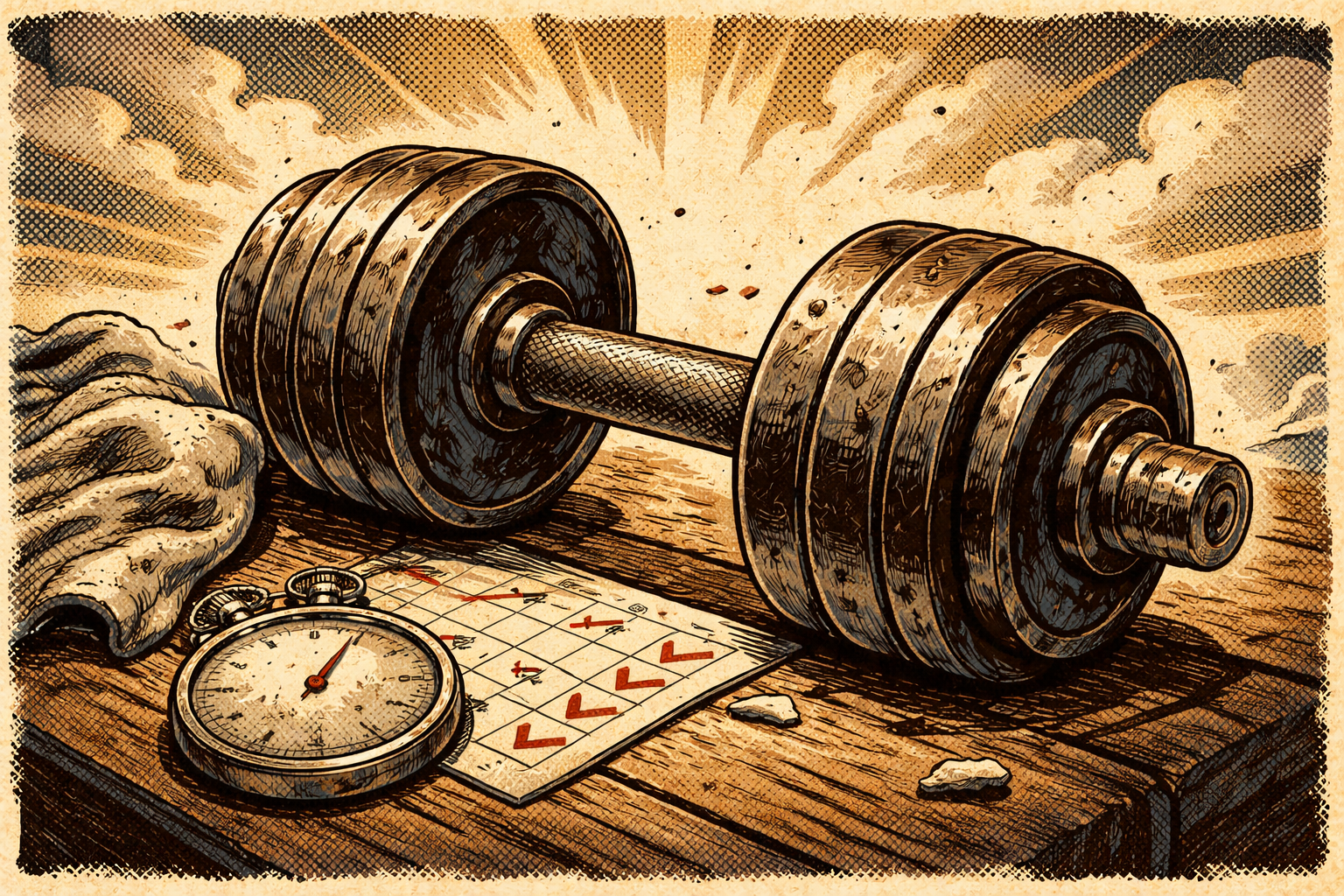
Within the larger system of growth, this work belongs to the Forge, where energy becomes identity. More specifically, it lives inside the component of the Anvil. The Anvil is the stable surface that allows force to become form. Without it, even the strongest strike does nothing.
A habit is an Anvil.
It anchors action to something fixed. A cue triggers a routine, and a reward closes the loop. The system is simple, but its effect is cumulative. After brushing teeth, perform twenty pushups. After finishing lunch, take a ten minute walk. After turning off the lights, read two pages instead of reaching for the phone.
The habit does not rely on feeling. It relies on placement.
Each repetition is small. Each one seems almost insignificant. But over time, these repetitions create grooves that guide behavior automatically. What once required effort begins to require only compliance.
The Anvil absorbs the chaos of intention and redirects it into something that can be shaped.
Why Motivation Feels Necessary and Fails
There is a persistent belief that change begins with a shift in mindset.
If a man could just feel more driven, more focused, more ready, the rest would follow. This belief is attractive because it promises transformation without friction. It places the burden on a moment of clarity rather than a system of repetition.
And occasionally, it works. A surge of motivation produces a burst of action. A new routine is attempted. A plan is followed for a few days, sometimes a few weeks.
Then the feeling fades.
What remains is not failure of character but absence of structure. Without an anchored loop, behavior drifts back to what is easiest, most familiar, most automatic. The system reverts to its default state.
Motivation creates spikes. Habits create lines.
A life cannot be built on spikes.
The Repetition That Rewrites Identity
Every habit is a vote.
Each time a man follows through on a small, defined action, he reinforces a version of himself. Not through affirmation, but through evidence. The identity is not declared. It is accumulated.
Tracking this process makes it visible. A mark on a calendar. A streak that extends across days. The record becomes proof that the action is no longer an exception. It is becoming a pattern.
When a habit is missed, the system does not collapse unless the man abandons it. The next repetition restores the pattern. Over time, the question shifts from whether the habit will be performed to when it will be performed.
That shift is where identity takes hold.
A man who trains daily does not negotiate with himself about training. A man who writes daily does not question whether he is a writer. The repetition removes the debate.
The Anvil has done its work.
The Return to a Controlled Pattern
The day that once drifted begins to change in small ways.
The phone is left in another room at night. The morning begins with a fixed sequence. A short walk becomes part of the midday rhythm. A glass of water replaces a second drink. None of these changes feel dramatic. None of them solve everything.
But they accumulate.
The day no longer unfolds entirely by default. Certain moments are claimed, anchored, protected. Over time, those moments expand. What was once a fragile routine becomes a stable structure.
The man does not feel entirely different. He is not suddenly transformed. But he is no longer drifting.
The direction has changed.
The Work That Cannot Be Delegated
A habit cannot be installed by intention alone. It must be built through repetition, reinforced through tracking, and protected through structure.
No one else can do this work.
The choice is narrow and specific. Select one habit. Define its cue. Execute its routine. Track its completion. Repeat it daily for a week. Adjust only when necessary. Continue.
This is not a test of motivation. It is a test of structure.
The Line Between Drift and Direction
A life is not shaped in moments of decision. It is shaped in moments of repetition.
The difference between drift and direction is not clarity of vision. It is the presence of an Anvil, a place where action lands consistently enough to take form.
The pattern will exist either way.
The only question is whether it will be chosen or inherited.
Choose one habit. Install it. Track it for seven days.
At the end of that time, the evidence will be clear.
Either you are beginning to shape yourself, or you are allowing the pattern to continue shaping you.