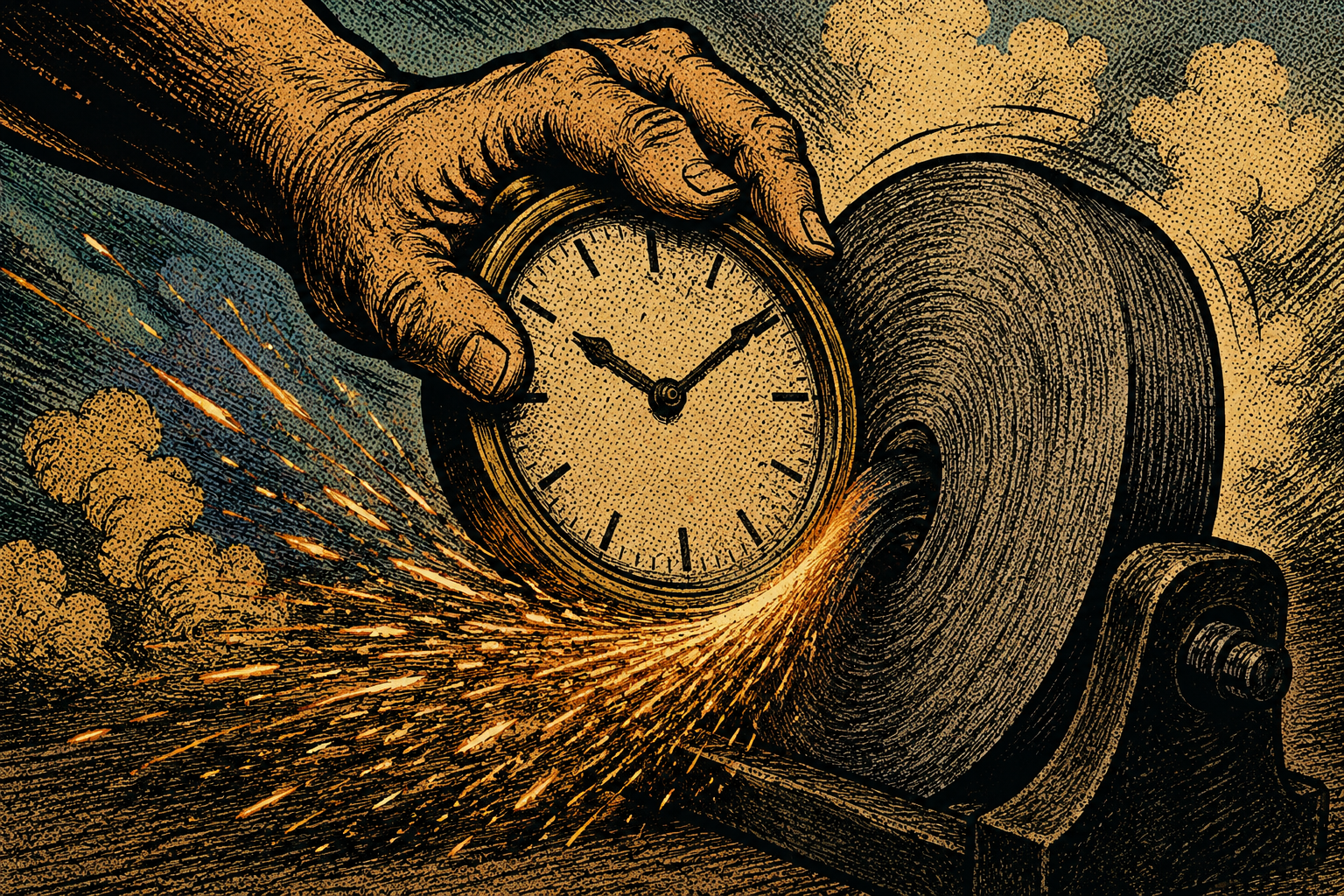
The Men Who Never Recover From One Bad Season
A man sits in his car outside the gym for twenty minutes and never goes inside.
He tells himself he’ll start again tomorrow. Tomorrow becomes next week. The missed workouts pile up quietly. The weight returns by degrees; the confidence disappears all at once. Restarting now feels harder than continuing to fail, because restarting requires an admission: he quit.
Another man keeps an unfinished business plan buried in a folder on his laptop. For almost a year, he worked on it every night after dinner. Then he showed it to someone whose opinion mattered to him. The response was flat. I don’t think there’s a market for this.
He hasn’t opened the file since.
A third man still tells the same story about the relationship that ended five years ago. He can recount every detail of the betrayal, every misunderstanding, every moment when things turned cold. What he cannot describe is his own role in the collapse. Over time, the story stopped being a memory and became a defense. Then it became an identity.
None of these men look broken from the outside. They go to work. They answer emails. They pay their bills on time. Their lives continue in the administrative sense.
But something in them has stalled.
One disappointment became more than an event. It became a verdict. The failed diet meant they lacked discipline. The failed business meant they lacked talent. The failed relationship meant they were unlovable. What hurt them was not the setback itself, but the meaning they attached to it.
Most lives do not unravel after catastrophe. They erode after discouragement.
The process is slow enough to hide inside ordinary routine. A man pulls back in one area of life, then another. He becomes careful where he used to be ambitious. Eventually he organizes his life around avoiding the feeling of failure altogether.
His world shrinks.
Not because opportunities vanished, but because risk began to feel intolerable.
He still admires disciplined people. He still talks about purpose and potential. He still imagines a larger version of his life. But internally he is negotiating with old humiliations he never examined closely enough to understand.
That negotiation shapes more men than obvious defeat ever will.
Failure Does Not Ruin Men. Interpretation Does.
Modern culture tends to treat failure in one of two dishonest ways.
The first treats it as permanent judgment. A failed marriage becomes proof that someone is damaged. A failed business becomes evidence that someone was never meant to lead. Mistakes harden into identity.
The second approach swings toward motivational theater. Every setback is recast as hidden progress. Every collapse becomes “part of the journey.” People speak the language of growth while repeating the same mistakes for years.
Neither view survives contact with reality.
Failure is not a moral verdict. It is information.
That distinction matters because information can be used.
A failed attempt exposes something success often conceals: weak preparation, inflated confidence, emotional immaturity, bad timing, poor habits, shallow commitment. Sometimes the obstacle is external. More often the obstacle is personal.
This is why failure feels so intimate. It interrupts the story a man tells himself about who he is.
A man may believe he is disciplined until pressure reveals how quickly he quits. He may think he is patient until conflict exposes his impulsiveness. He may claim to want greatness until inconvenience reveals that what he actually wants is comfort with the appearance of ambition.
Failure drags self-image into contact with reality.
Most men are not simply trying to accomplish things. They are trying to preserve the belief that they are capable men. Once failure threatens that belief, the emotional problem becomes larger than the practical one.
This is why avoidance is so seductive.
A man who never fully commits to the business can still imagine he would have succeeded. A man who never trains seriously can keep believing he could get into shape “if he really wanted to.” A man who never risks vulnerability can continue imagining himself as a good partner under different circumstances.
Distance protects fantasy.
Reality destroys it.
And yet growth cannot happen anywhere else. Skill requires friction. Discipline requires resistance. Character requires consequences.
The men who improve are rarely the men who fail least. They are usually the men who learn how to read failure correctly.
Pride Is More Expensive Than Most Men Realize
Modern life trains people to avoid visible incompetence.
Schools reward correct answers more than experimentation. Offices punish mistakes while demanding innovation. Social media rewards presentation over process. Everywhere a person looks, there is pressure to appear capable before becoming capable.
The result is a culture full of fragile adults.
Fragility does not always look emotional. Often it looks polished, articulate, controlled. You see it when someone cannot tolerate correction, embarrassment, rejection, or uncertainty without experiencing those things as personal diminishment.
So they avoid the conditions that produce growth.
They avoid asking questions because they fear appearing ignorant. They avoid starting late because younger beginners embarrass them. They avoid competition because losing feels humiliating. They avoid accountability because accountability eliminates excuses.
At a certain point, protecting pride becomes a full-time occupation.
This is why some men stop developing long before they reach their limits. Their lives become systems designed to minimize discomfort rather than expand capability.
Many of them believe they are waiting for confidence before they act.
But confidence almost never arrives first.
A child learning to walk falls constantly without interpreting each fall as existential evidence. The process assumes instability. Adults lose that instinct because performance becomes entangled with identity. Falling no longer feels temporary. It feels revealing.
The older a man gets, the worse this can become. Responsibilities increase. Expectations harden. Public failure appears more costly. Eventually some men become so invested in looking competent that they avoid the experiences required to become wiser.
From the outside, their lives appear stable.
Underneath, growth has stopped.
The Men Who Become Better After Losing
Some men experience failure and emerge more disciplined afterward. Calmer. Less delusional. More effective.
The difference is usually not talent. It is interpretation.
These men do not treat failure as identity. They treat it as feedback.
That does not make disappointment painless. It simply means they can examine the problem without collapsing into self-protection.
The pattern appears everywhere.
Michael Jordan is remembered as an emblem of dominance, but one of the defining stories of his early life is that he was cut from his high-school varsity basketball team. The important detail is not the rejection itself. Thousands of athletes get rejected. What mattered was his response. He interpreted the setback as instruction rather than destiny.
Thomas Edison approached failed experiments the same way. Each unsuccessful attempt narrowed the field. Every mistake removed one more false path.
Failure, in that sense, acted as refinement.
That word matters because refinement implies pressure, correction, repetition. Metal strengthens under heat. Judgment improves through error. Skill develops through adjustment.
So does character.
Men who have never failed in meaningful ways often carry hidden weaknesses. Success can conceal laziness for years. Talent can compensate for poor discipline. Luck can disguise bad preparation.
Failure removes the disguise.
That is why some of the strongest people are not those who avoided setbacks, but those who learned how to examine them honestly without turning them into permanent verdicts about themselves.
That kind of honesty requires accountability.
Real accountability is not self-hatred. It is precision.
A man capable of accountability can say, I helped create this outcome, without concluding, I am worthless.
Shame and accountability may look similar from a distance, but they produce opposite effects.
Shame freezes people in place.
Accountability restores movement.
The ashamed man says, I failed because I am broken.
The accountable man says, I failed because something in my approach needs to change.
Only one of those sentences leads anywhere.
Time Does Not Automatically Make People Wiser
People like to say experience is the best teacher.
Usually it isn’t.
Experience repeats lessons. Reflection is what teaches them.
A man can spend twenty years reenacting the same mistakes with different faces, jobs, cities, or excuses. Time alone does not produce insight. Some people simply become older versions of the same unresolved person.
This is why repeated failure does not automatically create growth. A setback becomes useful only after someone studies it carefully enough to understand what actually happened.
Most people resist this because honest self-examination is unpleasant.
It is easier to blame timing than preparation. Easier to blame bad luck than inconsistency. Easier to blame other people than admit cowardice or pride interfered.
External conditions matter, of course. Economies collapse. Relationships involve two people. Health problems are real. Not every outcome is controllable.
But accountability remains valuable even then because it keeps attention fixed on what can still be shaped.
After failure, a man should be able to ask himself a few plain questions.
What happened?
What part of it was mine?
What assumption proved false?
What weakness did this expose?
What changes before the next attempt?
Without that process, people repeat themselves endlessly while changing only the scenery. They move to new jobs without improving their work ethic. They enter new relationships without changing how they communicate. They restart goals without changing the habits that ruined them the first time.
Then they call the pattern fate.
Usually it is just unexamined behavior.
The Men Who Learn Faster Than They Hurt
A skilled craftsman studies damaged work carefully.
A warped blade reveals something about heat, timing, or pressure. The flaw contains instruction. Ignore it, and the mistake returns.
Human failure works the same way.
The strongest men are not necessarily those who suffer least. Often they are the men who learn faster than they despair.
That ability changes everything.
It allows a man to survive embarrassment without retreating from life. It allows him to hear criticism without becoming defensive. It allows him to begin again after setbacks because he no longer mistakes failure for final judgment.
Pain does not disappear.
It becomes useful.
A culture terrified of failure produces performative people. People who curate appearances instead of building competence. People who confuse confidence with fragility hidden under good lighting.
A healthier culture would not glorify failure, but it would stop treating mistakes as permanent stains on identity. It would understand that competence is usually the product of correction. That resilience is built through contact with difficulty, not avoidance of it.
The central question was never whether a man would fail.
Every man will.
The real question is what happens after the failure arrives.
Some men spend the rest of their lives protecting their pride from reality.
Others adapt.
Only one of them keeps growing.