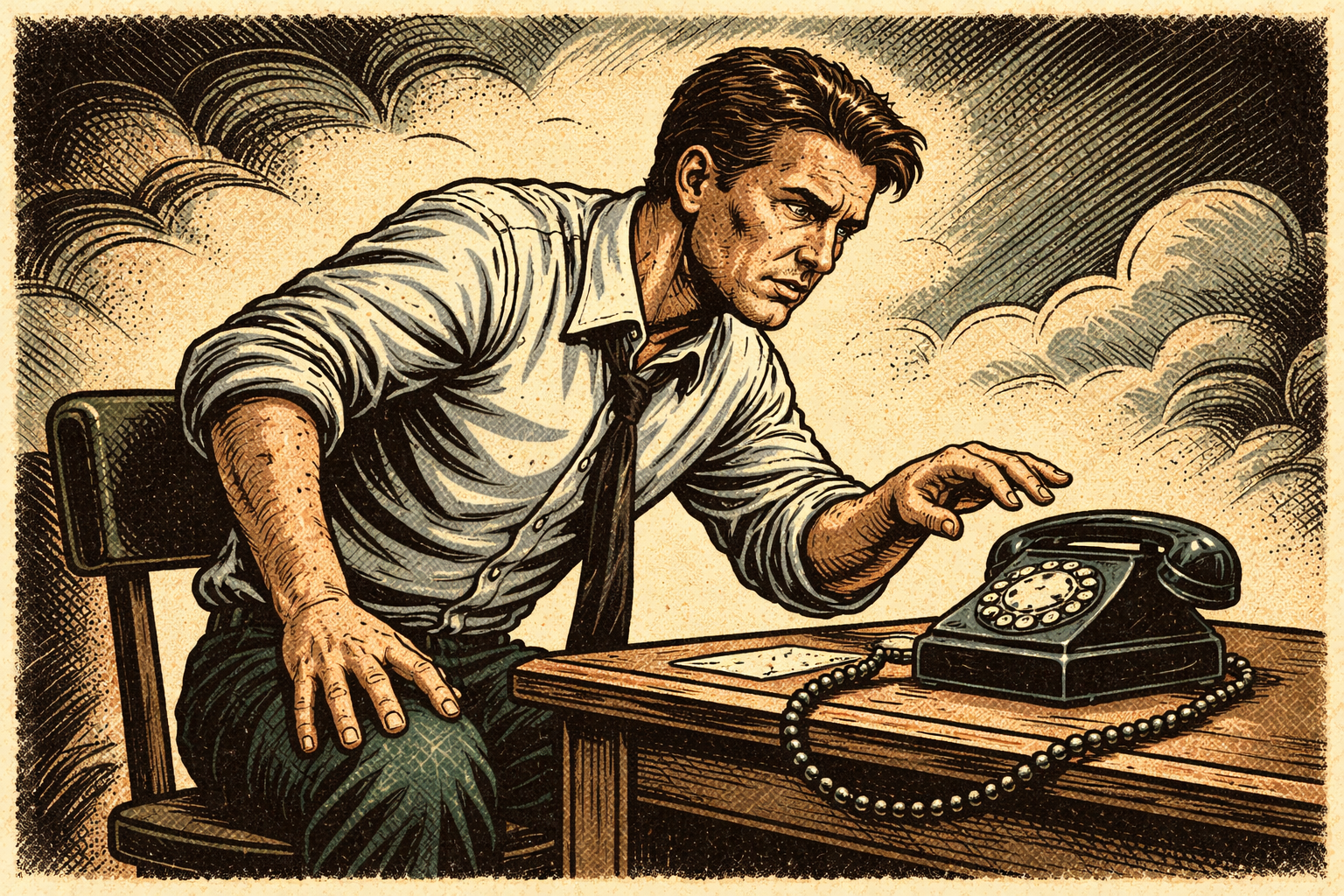
The Moment Before the Call
He stares at his phone longer than the call itself will take.
The number is already pulled up. The words are already formed. He knows what he needs to say. There is no confusion about the task. Only a quiet resistance that feels larger than the action itself.
Minutes pass. He checks something else. Then returns. Then hesitates again. It is not panic. It is not even strong emotion. It is a steady, low-grade pressure, just enough to keep his finger from moving.
This is how most fear operates. Not as a dramatic force, but as a subtle delay.
The call does not get made that day. It shifts to tomorrow, then later in the week, then becomes one more thing that lives in the background, quietly shaping behavior without ever being resolved. Nothing visibly breaks. Life continues. But something has been decided, even if he does not name it.
He has chosen to wait.
Fear Is Not the Obstacle, Avoidance Is
The common belief is that fear is what stops people. This is only partly true. Fear is present, but it is not decisive. What actually limits behavior is the pattern of avoidance that follows fear.
The thesis is simple: fear does not control a man through intensity, but through delay. It expands not because it is overwhelming, but because it is rarely tested.
This distinction matters. If fear were purely a matter of intensity, the solution would be emotional regulation or confidence. But most people are not paralyzed by unbearable fear. They are held back by manageable discomfort that they repeatedly choose not to face.
Avoidance converts temporary discomfort into a stable pattern. Each time a person delays action, the mind records that decision as a form of protection. Over time, this becomes a quiet agreement: when pressure appears, withdrawal is the correct response.
This is how fear grows without ever needing to escalate.
The Expanding Cost of Untested Assumptions
Fear is rarely based on direct experience. It is built on prediction.
A man avoids speaking up in a meeting because he imagines being wrong. He avoids reaching out because he imagines rejection. He avoids trying because he imagines failure becoming visible. These imagined outcomes feel real enough to guide behavior, even when they have not been confirmed.
Psychologically, this process is efficient. The brain is designed to simulate possible threats and reduce risk. But when simulation replaces action, the system becomes distorted. The imagined cost of action inflates, while the actual cost remains unknown.
This imbalance creates a feedback loop. The longer an action is avoided, the more significant it appears. The more significant it appears, the more it is avoided. What began as a small hesitation becomes a fixed boundary.
In practical terms, this is why relatively minor actions can feel disproportionately difficult. A short conversation becomes a major event. A simple decision becomes a prolonged dilemma. The gap between perception and reality widens.
What is missing in this loop is contact with reality. Without direct experience, fear has no corrective force. It operates unchecked.
Why Action Changes the Equation
Action interrupts prediction.
When a person takes the step they have been avoiding, several things happen at once. The imagined scenario is replaced with an actual one. The unknown becomes known. The anticipated consequences are measured against real outcomes.
Often, the result is less severe than expected. The conversation is uncomfortable but manageable. The rejection is brief, not catastrophic. The failure is contained, not defining. Even when outcomes are negative, they tend to be specific and limited, rather than expansive and identity-threatening.
This does not eliminate fear entirely. But it changes its scale and authority. Fear shifts from a broad, undefined threat to a narrower, more accurate signal.
Equally important, action produces evidence. It demonstrates that discomfort can be endured, that negative outcomes can be survived, and that uncertainty can be navigated. This evidence accumulates over time, forming the basis of confidence.
Confidence, in this sense, is not a prerequisite for action. It is a byproduct of repeated exposure to reality.
The Appeal and Limits of Preparation
A common response to fear is to prepare more.
People gather information, rehearse scenarios, and refine plans in an effort to reduce uncertainty. This can be useful up to a point. Preparation can improve performance and reduce obvious risks.
But preparation has limits. Beyond a certain threshold, it becomes a form of avoidance.
The belief is that more knowledge or better planning will eventually remove the discomfort associated with action. In reality, the discomfort is tied to exposure, not ignorance. No amount of preparation fully replicates the conditions of real engagement.
This is why well-prepared individuals can still hesitate. They have reduced the unknown, but they have not faced it. The final step, the transition from thinking to doing, remains unresolved.
Preparation can support action, but it cannot replace it.
The Misleading Ideal of Fearlessness
Another common interpretation is that progress requires eliminating fear altogether.
This belief is appealing because it suggests a clean solution. If fear can be removed, action will follow naturally. But in practice, fear rarely disappears before action. It tends to persist, even as behavior changes.
Waiting for fearlessness creates a condition that is never fully met. It reinforces delay, because the absence of fear becomes the requirement for movement.
More importantly, it misidentifies the role of fear. Fear is not necessarily a defect. It is often a signal of uncertainty, risk, or importance. The goal is not to eliminate it, but to respond to it appropriately.
People who appear fearless are often not without fear. They have simply developed a pattern of acting despite it. Their behavior is not driven by the absence of discomfort, but by a different relationship to it.
This distinction reframes the problem. The task is not to feel differently before acting, but to act in a way that gradually changes how fear is interpreted.
A Different Measure of Control
Returning to the man with the phone, the outcome is not determined by whether he feels ready. It is determined by whether he acts.
If he continues to wait, the call will remain unresolved, and the hesitation will extend into other areas. The pattern will repeat, not because the situations are identical, but because the response is consistent.
If he makes the call, the result may vary. It may go well or poorly. But the dynamic changes. The fear is tested. The prediction is challenged. A piece of evidence is created.
This is the central point: control is not established by eliminating fear, but by reducing the influence of avoidance.
The broader implication is that many limitations attributed to personality or ability are, in fact, products of untested assumptions. They persist not because they are accurate, but because they have not been confronted.
The Cost of Waiting and the Value of Contact
Fear, left untested, expands through delay. It shapes behavior quietly, without requiring dramatic intensity. It does not need to overwhelm to be effective. It only needs to persuade a person to wait.
The argument, then, is not that fear is insignificant. It is that its power is often misunderstood. It does not dominate through force, but through the absence of contact with reality.
Action changes this. It introduces friction between expectation and outcome. It generates evidence. It reduces uncertainty. Over time, it reshapes the internal model that guides behavior.
The implication extends beyond individual moments. A life structured around avoidance becomes narrower, not because opportunities disappear, but because they are not engaged. A life structured around contact becomes broader, not because risk is eliminated, but because it is repeatedly navigated.
The man with the phone faces a small decision. But the pattern behind it is not small. It is the difference between a life governed by prediction and one informed by experience.
The call, in this sense, is not just a task. It is a test of which pattern will continue.